

While Everyone Else Squeezes You for More, Valve Just Quietly Made Gaming Cheaper for Half the Planet

I spend most of my time on this site telling you about the ways the gaming industry is trying to squeeze more money out of you. Price hikes, shrinkflation, battle passes, deluxe editions, $70 standard prices, $900 consoles. It's a never-ending parade of corporate greed dressed up in PR language.
So when a company does the opposite? When a company looks at a broken system and says "let's actually fix this for people"?
Credit where credit's due. We're going to talk about it.
What Valve Actually Did
On March 28, Valve rolled out a major update to Steam's regional pricing tools. And unless you're a game developer logging into Steamworks, you probably didn't hear about it. That's kind of the point.
Here's the problem they're solving. Steam supports 35 currencies and four regional groups worldwide. When a developer publishes a game, they set a base price in US dollars, and Steam suggests what that price should convert to in every other currency. For years, the only conversion method available was a basic exchange rate calculation. And that system was broken.
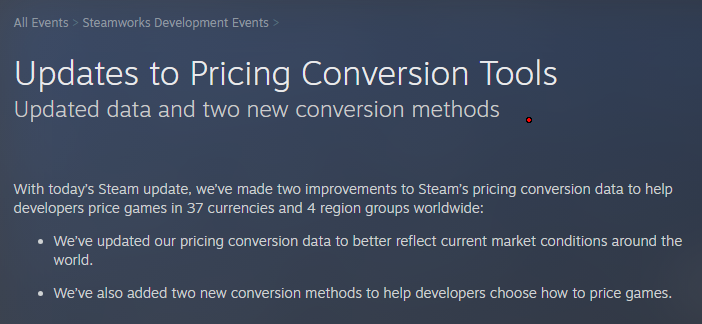
Gamers in Brazil, Poland, Argentina, Turkey, and dozens of other countries were routinely paying 20 to 30 percent more than the dollar equivalent for the same game. Not because of taxes. Not because of shipping. Because the conversion math didn't account for the fact that $60 in the United States is a very different ask than $60 in Brazil.
A YouTuber named Water CS2 made an entire video about this six months ago called "Steam Has a Pricing Problem." His point was simple. The regional pricing system was originally designed to make games affordable across different economies. Instead, it became a direct cause of the unfair prices Valve wanted to prevent in the first place.
Valve listened. And now developers have three conversion methods to choose from.
The first is the standard exchange rate. Straight math.
The second factors in purchasing power. It uses public data about the average economic capacity of customers in a given country. So if a game costs $20 in the US, this method might suggest $8 to $10 in Brazil, because that's what represents a comparable level of spending relative to income.
The third combines multiple data sources. Local purchasing power, the cost of comparable entertainment goods in the region, and the exchange rate. It's the most nuanced option and it's closest to what Valve's old system tried to do, but with significantly better data.
That's it. No press conference. No marketing campaign. No "we hear you" thread. They just updated the tools, wrote a blog post explaining them, and said "your prices are between you and your customers."
Why This Actually Matters
I want to make something clear here. This isn't some tiny quality of life update. For hundreds of millions of gamers worldwide, this could meaningfully change what they pay for games.
Let's do the math. If a game costs $19.99 in the US, a straight exchange rate conversion might price it at roughly 790 rubles in Russia. The purchasing power method drops that to about 260 rubles. The multi-variable method lands around 465 rubles.
That's the difference between a game being affordable and a game being a luxury purchase.
And this isn't just about one country. We're talking about Southeast Asia, where countries like Indonesia, the Philippines, Thailand, and Vietnam have massive gaming populations with significantly lower average incomes. We're talking about Eastern Europe, Latin America, the Middle East, and North Africa.
Gaming is supposed to be global. But for years, the pricing structure has punished people for where they live.
Now, to translate this into normal human language. Valve built a tool that says to developers: "Hey, if you want your game to actually reach the people who want to play it, here's how to price it so they can afford it."
And here's the thing. The economics actually support this. A player in Brazil who can't afford $20 isn't a lost sale at $20. They were never going to buy at that price. But at $9? They might. You've created revenue from a market that would have generated zero otherwise. More sales mean more reviews, more concurrent players, more word of mouth, more algorithmic visibility. The math works.
The Contrast Is Deafening
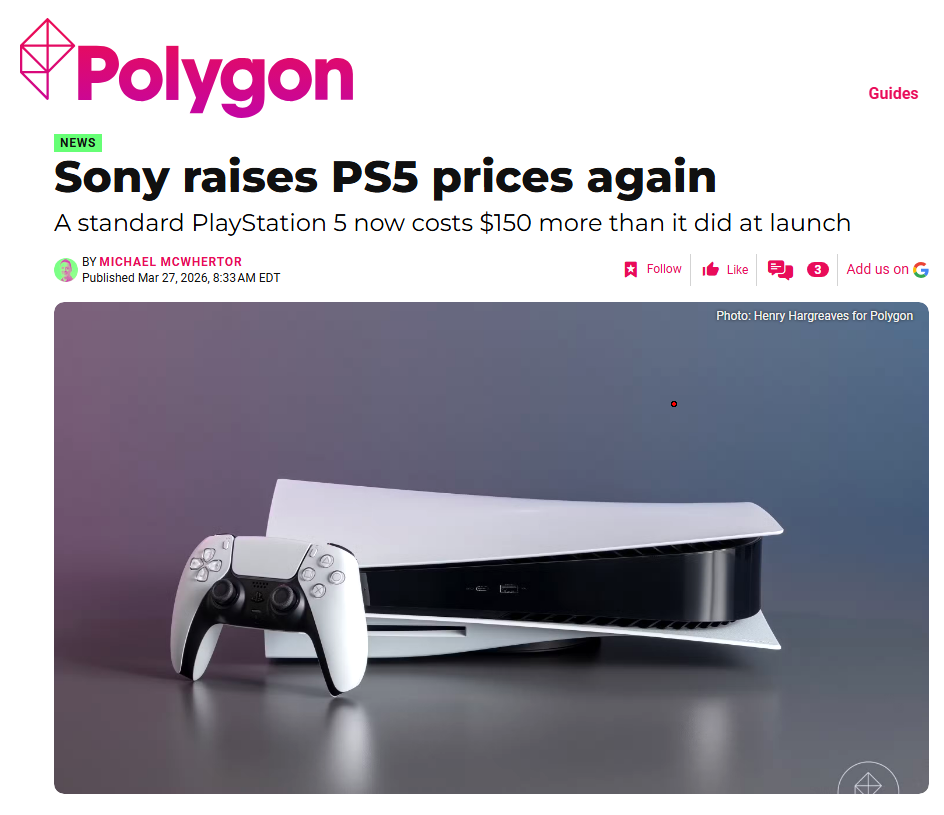
I published a piece two days ago about Sony raising the PS5 Pro to $899. About how they've closed eight studios since the PS5 launched while asking players to pay more for less. About Marathon, their flagship Bungie title, struggling at 1.2 million copies sold against what analysts estimate is a $250 million budget.
And then, on the same timeline, Valve is over here quietly building infrastructure to make games cheaper for people in developing economies.
That's the juxtaposition that tells you everything you need to know about where the industry is right now.
Sony raises prices. Valve builds tools to lower them.
Publishers push $70 as the new standard. Valve gives developers the data to charge what's actually fair in each market.
The industry talks about "reaching new audiences" while pricing those audiences out. Valve makes reaching them mechanically easier.
This is not complicated. This is what it looks like when a company's incentives are actually aligned with the people using their platform. Valve makes money when developers sell games on Steam. Developers sell more games when people can afford them. People can afford them when the prices reflect their actual economic reality. Everybody wins.
That is just insane to me. Not because it's complicated. Because it's so obvious and nobody else is doing it.
The Catch (Because There's Always a Catch)
Here's where I have to temper the enthusiasm slightly. These tools are opt-in. Developers and publishers have to manually choose a conversion method and update their prices. Valve is very clear about this. "Your prices won't change unless you manually submit and publish new prices."
And if history is any guide, the developers most likely to use these tools are indie developers. Small studios. The people already most in touch with their communities. The people already charging fair prices.
The big publishers? EA, Ubisoft, Activision, Square Enix? These guys have historically ignored regional purchasing power entirely. They set a global price and that's it. Take it or leave it.
So the real test isn't whether Valve built good tools. They did. The real test is whether the publishers who need to use them the most will actually bother.
I wouldn't hold my breath. But I also wouldn't be surprised if the data starts to tell a compelling story. If indie developers using these tools see measurably better sales in price-sensitive regions, and if that data becomes public, it creates pressure. Not moral pressure, because these guys clearly don't respond to that. Financial pressure. The only language they understand.
What Valve Gets Right That Everyone Else Gets Wrong
There's a broader point here that I think is worth sitting with.
Valve doesn't do press tours. Valve doesn't release statements saying "we hear the community loud and clear." Valve doesn't run apology campaigns or promise to "do better." They just do things.
The Steam Deck happened because Valve saw a market need and filled it. Steam's refund policy happened because Valve recognized that consumer protection was good for business. Steam Workshop, Steam Remote Play, Proton for Linux. None of these came with a marketing blitz. They just showed up.
And now Steam's pricing tools got a major upgrade because players and developers were saying the system was unfair, and Valve agreed.
There's a lesson in there for every publisher currently writing a "we hear you" blog post while raising prices and laying off developers. Stop talking. Start building.
I don't want to put Valve on a pedestal. They take 30% of every sale. Steam's storefront has its own discoverability problems. They're not perfect by any stretch.
But when I look at the gaming landscape in March 2026, where layoffs are relentless, prices are climbing, studios are closing, and every earnings call is about "cost optimization" and "right-sizing the workforce," Valve building tools to make games more affordable for people in 35 currencies is not nothing.
It's actually kind of refreshing. And I can't lie, that is absurdly refreshing.
Looking Forward
Valve also confirmed that they're updating the prices on their own games to align with the new conversion model. They're eating their own cooking. That matters.
The next few months will tell us whether this update actually changes prices in practice. Whether developers adopt the new tools. Whether players in Brazil and Turkey and Poland and Indonesia see real differences when they open their wishlists.
If they do? This is a Pendulum Watch moment. Another example of the platform that actually respects players quietly gaining more ground while the publishers that don't keep wondering why their audience is shrinking.
And if they don't? If the big publishers ignore these tools entirely and keep charging global flat rates? Then we'll have even more evidence of what we already know. That these guys aren't interested in growing gaming. They're interested in extracting from it.
Either way, Valve did their part. The tools are live. The data is updated. The door is open.
Whether the industry walks through it is a different question entirely.
Share this article
Comments
Related Articles

Mortal Shell 2 Looks Incredible. And It's Being Made by 30 People.
Cold Symmetry left AAA in 2017 with four developers. Mortal Shell sold 2 million copies. Now Mortal Shell 2 has 60+ handcrafted dungeons, an open world, firearms, and a team of 30. This is how indie gets it right.

"It Was Just a Placeholder." The Gaming Industry's Favorite AI Excuse Has Become a Script.
Three studios. Three apologies. The same sentence. The problem isn't AI in development. It's that nobody disclosed it until players caught them. The pattern is undeniable.

Crimson Desert Is Already Breaking Records and It Hasn't Even Launched Yet
Crimson Desert Is Already Breaking Records and It Hasn't Even Launched YetThree million wishlists. Four hundred thousand pre-launch copies sold on Steam alone. Over $20 million in revenue before a...
You May Also Like

REPLACED: Eight Years, a War, and Zero Compromises
The game was finished. The reviews were positive. They delayed it anyway.
One Guy. No Publisher. No Multiplayer. $15. Road to Vostok Just Launched and It's Already Winning.
A solo Finnish developer turned down every publisher, ported his game from Unity to Godot in 615 hours, released four free demos, and just launched a $15 hardcore survival game to 5,000+ day-one players and Very Positive Steam reviews. Full breakdown at EarlyMeta.

Eidos Montreal Spent Hundreds of Millions on a Game Nobody Will Ever Play. Then They Fired 124 People.
Seven years. Four game engines. Hundreds of millions of dollars. A Deus Ex sequel killed to fund it. Then Embracer canceled Wildlands and fired 124 people. Full breakdown with receipts.