
Epic Games Laid Off 1,000 People Five Days After Charging Fortnite Players More Money

How do you raise the price of your in-game currency on March 19, tell your players the cost of running the game "has gone up a lot," and then fire 1,000 employees on March 24?
That's not a rhetorical question. I genuinely want to know how that works. Because when you lay out the timeline of what just happened at Epic Games, the picture it paints is not great.
And the data makes it worse.
The 14-Day Timeline That Tells You Everything
Let's walk through this, because when you see the dates lined up, it hits differently.
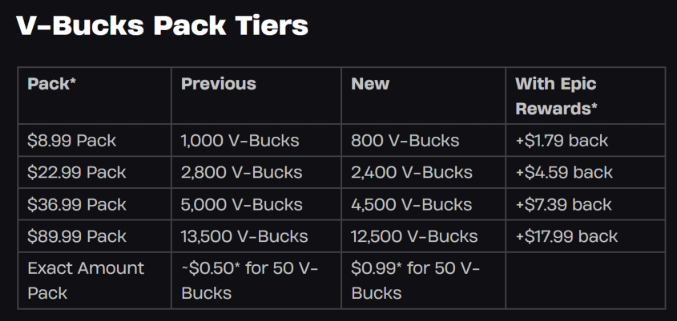
March 10, 2026. Epic Games announces a V-Bucks price increase. Not a price increase in the traditional sense. The dollar amounts on the packs stay the same. But the amount of V-Bucks inside each pack gets slashed. The $8.99 pack that used to give you 1,000 V-Bucks now gives you 800. That is a 20% cut in value for the exact same price. Classic shrinkflation. The Battle Pass reward V-Bucks drop from a total of 1,500 down to 800. Fortnite Crew subscribers lose 200 V-Bucks from their monthly grant.
The reason given? Direct quote from Epic. "The cost of running Fortnite has gone up a lot and we're raising prices to help pay the bills."

March 19, 2026. The price increase goes live with the launch of Chapter 7 Season 2. Players immediately feel it. The surplus V-Bucks you used to earn from completing a Battle Pass? Gone. There is now zero margin. If you spend a single V-Buck on anything outside the pass, you have to buy more to afford the next one. The cycle of earning your way to the next season's pass without spending additional money is effectively over for most players.
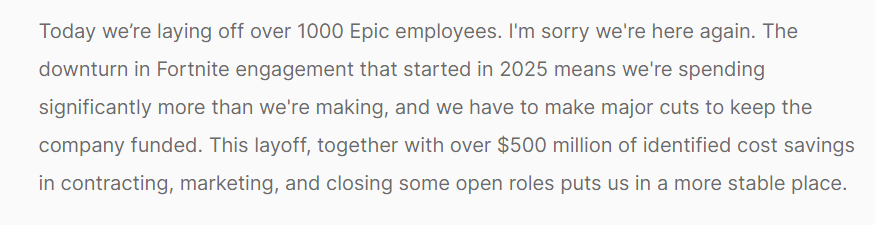
March 24, 2026. Five days later. Epic Games lays off over 1,000 employees. That is roughly 20% of their entire workforce. Tim Sweeney, Epic's CEO, posts a memo to staff that the company also made public. In it, he says the "downturn in Fortnite engagement that started in 2025" means they are spending significantly more than they are making. On top of the layoffs, Epic identifies $500 million in additional cost savings from contracting, marketing, and closing open roles.
On the same day, Epic announces it is shutting down three Fortnite game modes. Ballistic and Festival Battle Stage go offline April 16. Rocket Racing shuts down in October. The reason? Epic says they "failed to build something awesome enough to attract and retain a large player base."
Fourteen days. Price hike, mass layoff, mode shutdowns. All in two weeks.
Let that sink in.
The Numbers Behind the Collapse
And to be honest with you, the numbers make this even harder to process.
Fortnite has generated over $20 billion in revenue since it launched in 2017. That is not a typo. Twenty billion dollars.
In February 2024, Disney invested $1.5 billion in Epic Games for a minority stake, specifically to build a persistent Disney universe inside Fortnite. That money came in just over two years ago.
So where did it all go?
According to Circana's Player Engagement Tracker, Fortnite was still the most-played game on both PlayStation and Xbox in February 2026. On PlayStation, 35% of active players were in Fortnite. On Xbox, 31%. Those are dominant numbers by any measure.
But here's the thing. The time those players spent in the game is dropping. Hard. The average PlayStation user played Fortnite for 16 hours in February 2026. A year earlier, that number was 21 hours. Xbox users dropped from 19 hours to 15. That is a significant decline in engagement even while the player count itself remains high.
The daily active player count tells a similar story. Estimates from third-party trackers show Fortnite averaged over 2 million daily players in late 2024. By early 2026, that number had fallen to roughly 1.2 to 1.4 million. Still massive by any standard. But the trend line is pointing down, and it has been for over a year.
Sweeney acknowledged this in his memo when he pointed to "slower growth, weaker spending, and tougher cost economics" as industry-wide problems. He also mentioned consoles selling less than the previous generation and games competing for time against other forms of entertainment. All valid points.
But none of those are new. And that's where this starts to feel less like a surprise and more like a pattern.
We Have Seen This Before. Literally.
This is Epic's second mass layoff in three years.
In September 2023, Epic laid off 830 employees. That was roughly 16% of their workforce at the time. Sweeney's message back then was almost identical. Costs were too high. Revenue wasn't keeping up. Tough decisions had to be made. The company had been spending "way more money than we earn."
That was two and a half years ago. And now here we are again, except it is worse. More people. Higher percentage of the company. And this time, they are also killing game modes and raising prices on players at the same time.
I don't want to repeat myself, but this needs to be said clearly. If the 2023 layoffs were supposed to right the ship, what happened? If the $1.5 billion from Disney was supposed to fuel growth, where did that growth go? If Fortnite was generating billions in revenue year after year, how are they spending more than they make?
Those are not unfair questions. Those are the obvious questions.

The V-Bucks Math That Nobody Is Talking About
Let's do the math on what this price increase actually looks like for players, because Epic framed it as a necessary cost adjustment. As if their hands were tied.
Before March 19, a player who bought the $8.99 V-Bucks pack and used it on the Battle Pass could earn back 1,500 V-Bucks by completing the pass. That gave them the next season's pass and 500 V-Bucks left over for cosmetics or emotes. It rewarded engagement. Play more, earn more. Simple.
After March 19, the same $8.99 pack gives 800 V-Bucks. The Battle Pass costs 800 V-Bucks. You earn back exactly 800 V-Bucks from completing it. Zero surplus. Zero flexibility. One impulse purchase in the Item Shop and you need to buy another pack to afford the next pass.
And the Bonus Rewards V-Bucks that used to pad the return? Removed entirely.
This is not the first time Epic has done this either. They raised V-Bucks bundle prices by 12 to 15 percent back in late 2023. Right around the time of the last mass layoff.
And here is the part that drives players up the wall. Five days after telling players they need to pay more because costs went up, Epic fired 1,000 of the people who actually make the game. The people whose work is the product that generates those billions. The artists, engineers, designers, and programmers who built the thing that made $20 billion.
That sequence of events tells you everything you need to know about who is being asked to absorb the consequences of management's decisions.
Three Modes Dead. One Admission Worth Noting.
When Epic announced the mode shutdowns on the same day as the layoffs, there was one line in the statement that stood out.
"We've built a lot of Fortnite modes, and in some cases we failed to build something awesome enough to attract and retain a large player base."
Credit where credit's due. That is an unusually honest statement from a major publisher. Most companies would never admit failure that directly. They would call it a "strategic pivot" or say they are "reallocating resources to better serve the community." Epic just said they failed.
Ballistic, their Counter-Strike style competitive FPS mode, launched in December 2024 and is being removed in April 2026. Roughly 16 months of life. Rocket Racing, which launched in late 2023, gets until October. Festival Battle Stage goes the same day as Ballistic.
Content creator Typical Gamer even publicly offered to buy Ballistic from Epic and maintain it independently. That is where we are at right now. Creators are asking to rescue modes from the company that made them because the company cannot sustain them.
What This Really Means for Players
Look, I'll be honest with you. Fortnite is not dying. It is still the most-played game on consoles. It still draws millions of players every day. It is still a cultural force.
But something has shifted. The Fortnite machine that once felt unstoppable is now visibly straining. The expansion into every possible game mode. The live events. The collaborations. The metaverse ambitions. The Disney integration. All of it costs money, and all of it was built on the assumption that engagement would keep growing or at least hold steady.
That assumption was wrong. Engagement is declining. And now the people paying for that miscalculation are the employees who got laid off and the players who are being asked to spend more for less.
Epic's Epic Games Store, which was supposed to be the company's second major revenue pillar alongside Fortnite, is only "marginally profitable" according to its own general manager. PC players spent $1.16 billion on the store last year. But with Epic taking just a 12% cut on third-party sales and still running its costly free games program, the store is barely breaking even.
That means Fortnite is still carrying the company. And when Fortnite's engagement drops, everyone feels it. The employees feel it first.
The Bigger Picture
Sweeney said something in his memo that I think is worth paying attention to. He said "market conditions today are the most extreme we've seen since those early days." He compared the current moment to the upheavals Epic survived in the 1990s and 2000s.
That is not the language of a company making routine adjustments. That is the language of a company that recognizes it is in real trouble.
And Epic is not alone. This is the same industry that has seen Battlefield Studios lay off staff after launching one of the most successful games of 2025. The same industry where Sony shut down Bluepoint Games. Where Riot laid off 80 people after 2XKO launched. Where Highguard launched and was fully shut down weeks later. Where Ubisoft cut over 100 employees from Red Storm Entertainment.
The pattern is always the same. Overspend, underdeliver, lay off the people who did the work, and then tell the public it was necessary.
And somehow, yet again, the people at the top who made the decisions that led to the overspending are not the ones losing their jobs.
What Comes Next
Epic says it is going to focus on building "awesome Fortnite experiences with fresh seasonal content" and accelerating developer tools as they move from Unreal Engine 5 to Unreal Engine 6. Sweeney teased "huge launch plans towards the end of the year" tied to the next generation of Epic.
Maybe those plans materialize into something great. I genuinely hope they do. Not for Epic's shareholders. For the players who love Fortnite. And for the developers still at the company who now have to carry the weight of a mission designed for a team 20% larger than the one that remains.
But the timeline does not lie. You cannot charge players more on March 19, fire 1,000 employees on March 24, and expect anyone to look at that and feel good about the direction things are heading.
This didn't have to happen. And that's what makes it worse.
Links to related articles -
Highguard - https://earlymeta.com/article/highguard-is-dead-45-days-thats-all-it-got
Share this article
Comments
Related Articles

One-Third of US Game Developers Were Laid Off in Two Years. The Industry Did This to Itself.
The GDC 2026 report surveyed 2,300 professionals and the numbers are devastating. 33% of US devs laid off, 74% of students afraid to enter the industry, and 82% want unions. Here's the full breakdown.
Crimson Desert Sold 2 Million Copies in 24 Hours. Wall Street Says It's a Failure.
EA Laid Off Battlefield 6 Devs After the Biggest Launch in Franchise History. Let That Sink In.
Battlefield 6 was the best-selling game in America. It dethroned Call of Duty for the first time in 23 years. And EA just laid off the developers who made it.
You May Also Like
Best Indie Games Under $30 That Are Better Than $70 AAA Games in 2026
Slay the Spire 2 hit 574K concurrent players at $25. Schedule I has 98% positive reviews from one developer. Here's every indie game under $30 outperforming AAA in 2026.
Krafton's CEO Used ChatGPT to Scheme His Way Out of a $250 Million Payout. A Judge Just Destroyed Him.
The PUBG maker's CEO ignored his own legal team, took advice from ChatGPT, built a secret task force called "Project X," and tried to cheat Subnautica's creators out of $250 million. A Delaware court just shut it all down.
Crimson Desert Is Already Breaking Records and It Hasn't Even Launched Yet
Crimson Desert Is Already Breaking Records and It Hasn't Even Launched YetThree million wishlists. Four hundred thousand pre-launch copies sold on Steam alone. Over $20 million in revenue before a...