

One-Third of US Game Developers Were Laid Off in Two Years. The Industry Did This to Itself.

The GDC 2026 State of the Game Industry Report just dropped, and the numbers are devastating. One in three US game developers lost their job in the last two years. Not one in ten. Not one in five. One in three. And the next generation of developers? They're already looking for the exit before they even walk through the door.
I'm going to walk you through all of it. The layoffs, the AI backlash, the union push, and why every single one of these numbers points to an industry that broke itself and is now wondering why nobody wants to stick around and pick up the pieces.
33% of US Game Developers Lost Their Jobs
Let me start with the headline number because it needs to hit you the way it hit me.
The GDC surveyed over 2,300 game industry professionals for their 2026 report. Of US-based respondents, 33% said they were laid off in the past two years. Globally, that number was 28%. And half of all respondents said their current or most recent employer conducted layoffs in the past 12 months.
I'm going to say that again as clearly as possible. Half the people who took this survey work at a company that cut staff in the last year. Half.
And here's the thing. This isn't evenly distributed. Two-thirds of respondents at AAA studios said their company had layoffs. That's not a correction. That's not a "market adjustment." That's a gutting. When two out of every three people at a major studio have watched coworkers get escorted out, you don't get to call that business as usual. That's a crisis.
One-third of indie studio workers reported layoffs too. So it's not just the big publishers. The bleeding is everywhere.
The Receipts Are Everywhere. Just Look at 2026 So Far.
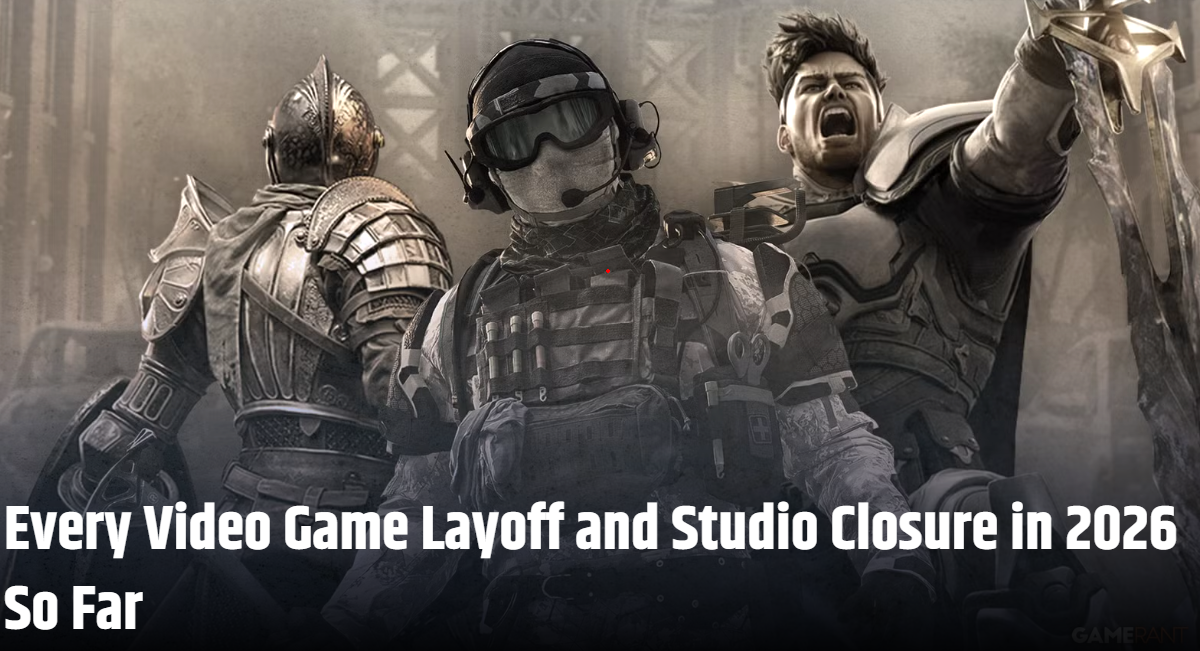
And if you think the GDC data is just a survey, just numbers on a page, let me walk you through what's actually happened in the first three months of 2026 alone.
Crystal Dynamics just announced its fourth round of layoffs in 12 months. Four separate rounds. March 2025, August 2025, November 2025, and now March 2026. At least 67 developers gone. And every single time, the same LinkedIn post. "Crystal Dynamics remains fully committed to the future development of our already announced Tomb Raider titles." Four times. The same message. While the studio shrinks around it.
These guys had 273 employees when Embracer acquired them in 2022. How many do they have now? Nobody's giving a firm number, and that tells you everything you need to know.
EA laid off a massive chunk of the Battlefield team across Criterion, DICE, Ripple Effect, and Motive Studios. And here's what makes this one absolutely insane. Battlefield 6 was the best-selling game of 2025. The highest-selling game in the United States last year. Record sales for the franchise. And these guys still fired the people who made it. EA called it a "realignment" as the game transitions to live service support. Now to translate that into normal human language. "Thanks for building the most successful Battlefield game ever. You're fired."
Sony shut down Bluepoint Games. Roughly 70 developers out the door. The studio that gave us the Demon's Souls remake, the Shadow of the Colossus remake. Gone. After their Bloodborne remake pitch got shot down and a God of War live-service project stalled out, Sony just closed the whole thing.
Ubisoft has been on a rolling layoff streak since 2025 and it hasn't stopped. They closed their recently unionized Halifax studio. They cut 55 jobs across Massive Entertainment and Ubisoft Stockholm. They laid off 40 people at Ubisoft Toronto. They shut down Red Storm Entertainment, a studio that's been around for 30 years and basically built the Tom Clancy franchise. And they're not done. There's talk of hundreds more cuts at the Paris headquarters. Their unions are calling for international strikes.
Meta closed three VR studios in a single day. Sanzaru, Armature, and Twisted Pixel. Just gone.
Playtika cut 500 employees, 15% of their entire workforce, and specifically cited wanting to use more AI-dependent resources and rely less on headcount. Let that sink in. They literally said the quiet part out loud.
Highguard launched, peaked at 97,000 players on Steam, and shut down permanently 45 days later. The studio laid off most of its staff before pulling the plug entirely.
This is not a list of isolated incidents. This is a pattern. This is the pattern. And the GDC report just gave us the data to prove what everyone in the industry already knew.
The Next Generation Is Already Giving Up
And you know what makes this entire thing that much more devastating?
The GDC report also surveyed students studying game development. 74% of them said they are concerned about their future job prospects in the game industry. Three out of four students training to enter this field are already worried about whether there's a field left to enter.
87% of game educators said they believe it will be harder for their graduates to find jobs. The people teaching the next generation of game developers are telling them it's going to be rough out there.
And the reasons students gave? Lack of entry-level jobs. Increased competition from laid-off workers who already have years of experience. And AI-led displacement.
That's bad. That's really bad.
Think about what this means for the long-term health of the industry. You're not just losing the people who are building games right now. You're scaring away the people who would be building games five years from now. The fresh ideas. The new perspectives. The next generation of creative talent that might have built something incredible if they weren't watching studio after studio implode before they even finish their degree.
This industry is eating its own future. And somehow, yet again, the people running these companies don't seem to realize it.
The AI Reality Check
Okay, now here's where I'm going to say something that might catch some people off guard.
52% of game industry professionals now say generative AI is having a negative impact on the game industry. That's up from 30% last year. And 18% the year before that. In two years, the number of people who think AI is bad for gaming has nearly tripled. Only 7% said it's having a positive impact. Down from 13% last year.
And look at who thinks AI is good for the industry. Executives and business operations people. 19% of them think it's positive. Meanwhile, the people actually making the games? Visual and technical artists are 64% negative. Game designers and narrative people are 63% negative. Programmers are 59% negative.
I understand the frustration. I do. But I also think we need to be honest about something. AI is not going anywhere. It is not a fad. It is not a bubble that's going to pop. It is affecting every single job sector on the planet, not just gaming, and pretending otherwise is not going to help anybody.
We've been here before. When computers started entering the workforce, people lost jobs. When machines proved more reliable at heavy industrial tasks, entire sectors restructured overnight. When cars were invented, you could have made a fortune shorting every horse and carriage business in the country. That's how technology works. It disrupts, it displaces, and then it becomes the new normal. And the people who adapt early are the ones who come out ahead.
Now here's the thing. The hurt from AI in gaming is real, but it's primarily a jobs hurt. It's the fear of displacement, the fear of being replaced by a cheaper tool. And that fear is completely valid, especially in an industry that just laid off a third of its workforce. When Playtika says out loud that they're cutting 500 people specifically to move toward AI-dependent resources, yeah, that's terrifying.
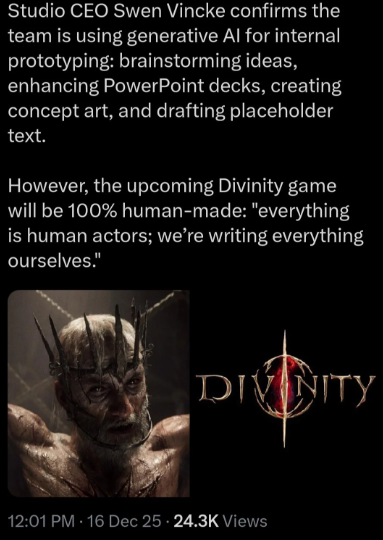
But from a creative and quality standpoint? The results tell a different story. Arc Raiders used AI for voice lines and got rightfully criticized for it, but then Embark's CEO came out and admitted that real professional actors are simply better. And they started replacing the AI lines with human performances. The game has sold over 14 million copies. Clair Obscure: Expedition 33 was one of the best-reviewed games of 2025 and used AI tools during development. Larian Studios, the team behind Baldur's Gate 3, one of the most beloved games in recent memory, has used AI as part of their workflow. These studios are getting praised, not buried.
36% of game industry professionals are currently using generative AI tools as part of their job. The most common use? Research and brainstorming at 81%. Then daily tasks like writing emails at 47%. Code assistance at 47%. Prototyping at 35%. Most of these people aren't using AI to replace creative work. They're using it the way most professionals in most industries are using it. As a tool to handle the tedious stuff so they can focus on the stuff that matters.
The real danger isn't AI itself. The real danger is executives using AI as a justification to cut headcount even further in an industry that's already bleeding. That's the part that should scare people. Not the technology. The people making the decisions about how to deploy it. Because we already know these guys will use any excuse to trim the budget and call it innovation.
82% Want Unions. The Industry Created This Too.
This is the number that should terrify every executive in every boardroom.
82% of US-based respondents support the unionization of game industry workers. Only 5% were opposed. Among workers earning under $200,000 a year, that support jumps to 87%. Among people who were laid off in the past two years, it's 88%.
And this is the one that stopped me. Among respondents aged 18 to 24, zero percent were opposed to unionization. Not a single young worker in the survey said they were against unions. Not one.
Right now, 10% of respondents are members of an industry-wide union like the United Videogame Workers-CWA, which launched at GDC just last year. Another 2% are in a company union. Those numbers are small. But 62% of professionals said they were interested in joining a union.
The demand is there. The frustration is there. The only question is how fast the organizing catches up.
And to be honest with you, the industry did this to itself. When you lay off a third of the workforce in two years, when you close studios that just shipped record-breaking games, when you fire developers and then post LinkedIn messages about how "fully committed" you are to the project those developers were building... you don't get to be surprised when the remaining workers decide they need collective bargaining power. You created this. Every round of layoffs, every "realignment," every hollow reassurance pushed more people toward the conclusion that they cannot trust management to protect them.
Consequences as language. The workers learned it the same way the players did.
The Self-Inflicted Crisis
Look, I'll be honest with you. There's a part of me that wants to find some nuance here. There's a part of me that wants to say, "Well, the pandemic boom inflated the industry and now it's correcting." And that's true to some extent. The COVID years saw a massive hiring surge followed by a market that cooled off. That's real.
And then I snap out of it.
Because the "correction" argument falls apart the second you look at what's actually happening. EA doesn't lay off the Battlefield team because of a post-pandemic correction. They lay them off after record sales because they want to squeeze live-service margins out of a smaller team. Ubisoft doesn't close Red Storm Entertainment after 30 years because the market shifted. They close it because they've been mismanaging their portfolio for a decade and they need to cut costs to survive restructuring after restructuring.
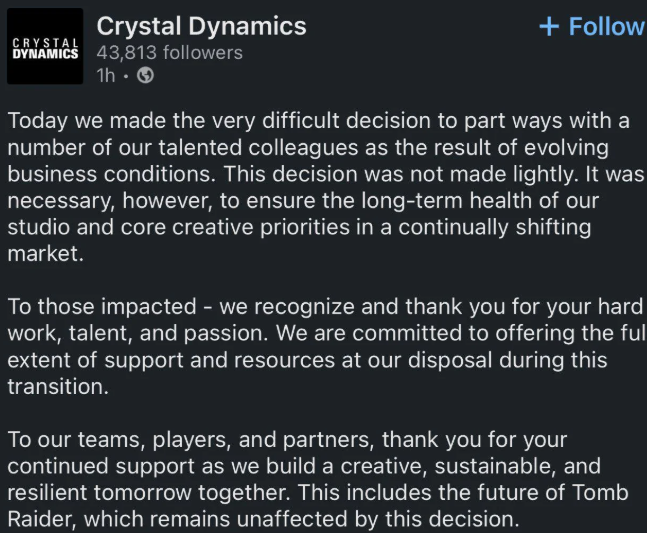
Crystal Dynamics doesn't fire 67 people across four separate rounds in a single year because the industry is "correcting." They do it because their parent company Embracer went on a reckless acquisition spree, overpaid for everything, and is now gutting studios to make the balance sheet look healthier.
This isn't a natural market cycle. This is the result of years of overexpansion driven by investor expectations, followed by contraction that falls entirely on the people who actually make the games. The executives who made the decisions that led here are not the ones losing their jobs. The artists, the engineers, the designers, the QA testers, the community managers. Those are the people paying for someone else's mistakes.
We've seen this story before. Over and over and over again.
Where This Goes From Here
An estimated 45,000 jobs were lost across the game industry between 2022 and mid-2025. The layoffs peaked in early 2024, and while the pace slowed in 2025, it clearly hasn't stopped. 2026 is barely three months old and the list of affected studios is already long and getting longer.
The GDC report isn't just data. It's a snapshot of an industry at a crossroads. One-third of its US workforce gone. The next generation of talent too afraid to enter. AI becoming another tool for executives to justify headcount cuts. And 82% of the workforce saying they need protection from the very companies they work for.
That's not a healthy industry. That's an industry that pushed too hard, hired too fast during the boom years, chased too many live-service dreams, and is now passing the bill to the people who had the least say in any of those decisions.
The pendulum is swinging. Indie studios are picking up talent that AAA threw away. Self-funding is the primary path for over a third of developers now. The people who got pushed out aren't disappearing. They're going somewhere. And increasingly, that somewhere is smaller teams, leaner projects, and games built with a creative vision instead of a quarterly earnings target.
The question isn't whether the industry can recover. It always does, eventually. The question is what it looks like on the other side. Because right now, the data says the people who build the games don't trust the people who run the companies. The students who would replenish the talent pool are questioning whether it's worth the risk. And the workers who remain are organizing to make sure what happened to their colleagues doesn't happen to them.
This didn't have to happen. And that's what makes it worse.
Share this article
Comments

James Brooke
Founder & Editor
Gaming industry analyst and video editor covering gaming trends, indie games, and industry analysis.
About the author →Related Articles
Bungie Just Cut Half Its Studio. 400 People Gone. What's Even Left?
Over 400 people on a single layoff call. Half the studio. Marathon can't hold an audience. Destiny is over. The studio that made Halo is heading toward extinction and nobody can explain what comes next.

Bungie Just Killed Destiny for a Game Nobody Wanted
Sony paid $3.6 billion. Destiny is dead. Destiny 3 doesn't exist. More layoffs are coming. And the developers who built the franchise are being funneled into a game that 10,000 people play.

Slay the Spire 2 Review Bomb: Stop Telling Consumers What Counts
Three review bombs in two months. 80,000 negative reviews. And the only debate anyone wants to have is whether or not it's fair. We're asking the wrong question.
You May Also Like

Best Games August 2026: 5 Headliners and 5 Under the Radar
Game Freak outside of Pokemon. MGS4 finally on modern hardware. Hell Let Loose Vietnam. A Marvel fighting game from Arc System Works. August is the warm up lap before September destroys everything.
Latest Patch Notes in Gaming — Week of July 20–26, 2026
Battlefield 6 put boats in the game. Heroes of the Storm reworked Ragnaros. 2XKO overhauled its Fuse systems. Phasmophobia rebuilt 13 Willow Street. Ten games patched this week — here's every update.
The Mound: Brilliant Co-Op Mechanic, Rough Execution
The insanity system is unlike anything in co-op horror right now. You can't trust your own screen. But the game around that mechanic needs work. If ACE Team keeps building, something special is underneath.