
Highguard Is Dead. 45 Days. That's All It Got.
Forty-five days. From launch to lights out. That's all Highguard got before Wildlight Entertainment announced it's pulling the plug on March 12, 2026. And look, I'll be honest with you. There's a part of me that wants to feel surprised by this. But I just can't get there. Not anymore.
Highguard launched on January 26 to nearly 100,000 concurrent players on Steam. Within a week, it had lost 90% of them. By late February, the daily peak had fallen below 600. And now, less than two months after it entered the world, it's being erased from it entirely. Two million people tried this game. Two million. And basically none of them stuck around.
That tells you everything you need to know.
The Timeline of a Modern Disaster
Let me walk you through how fast this unraveled, because the speed of it is genuinely staggering.
December 2025. Highguard gets the coveted "one last thing" slot at The Game Awards. Geoff Keighley personally championed the game. Gave Wildlight the spot for free in a show where other companies were reportedly paying up to $1 million for similar placement. The trailer lands. And the internet collectively shrugs. Actually, it's worse than a shrug. Within minutes, the comments were flooded with "Concord 2" memes and people declaring the game dead on arrival.
Then Wildlight does something that still makes me shake my head. They go completely silent. No follow-up content. No community engagement. No dev diaries. Nothing. For an entire month. Their reasoning? They wanted to replicate the Apex Legends shadow drop strategy from 2019. Just announce, go dark, and let the game speak for itself at launch.
That's crazy to me. Apex Legends launched into a Battle Royale market that was hungry and expanding. It was 2019. Highguard launched into a hero shooter and live-service market that is oversaturated, hostile, and actively rejecting new entrants. These are not the same conditions. Not even close.
January 26, 2026. The game launches. Nearly 100K peak players on Steam. Sounds decent, right? Except the Steam reviews immediately tank to "Mostly Negative" with thousands of negative reviews pouring in on day one. By the next day, the concurrent player count had already dropped below 20,000. And it never recovered.
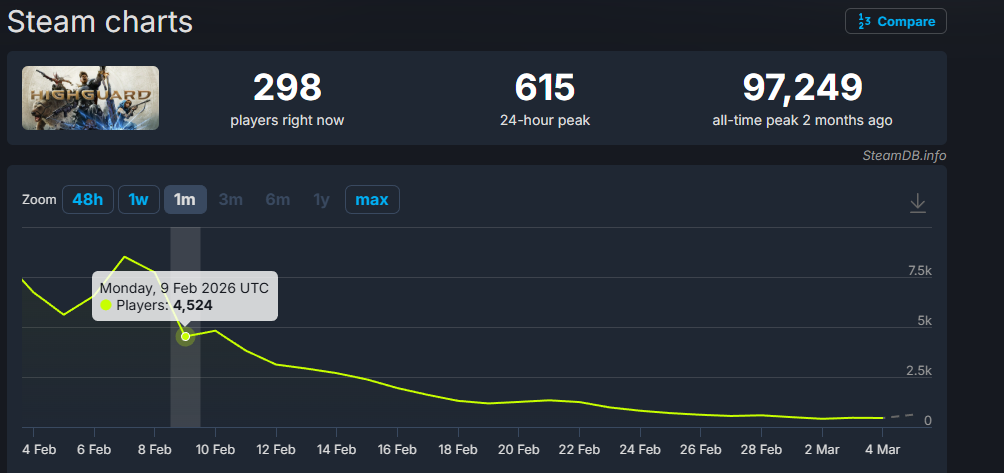
February 11. Just sixteen days after launch. Wildlight holds an all-hands meeting and tells the staff that Tencent, the game's secret financial backer, has pulled its funding. Most of the roughly 100-person team is laid off with what sources described as a "small" severance package. Fewer than 20 people remained.
March 3. Wildlight announces the game will permanently shut down on March 12. They're releasing one final content update. A new character, a new weapon, skill trees, account progression. Features that honestly might have helped if they'd been there at launch. But none of that matters now.
Forty-five days. Start to finish. And somehow, yet again, nobody in leadership saw this coming.
The Tencent Problem Nobody Wanted to Talk About
And here's the thing. For the entire development of Highguard, Wildlight presented itself as a scrappy, independent studio. CEO Dusty Welch told The Game Business that Wildlight was "an independent studio without the support of a big organization." When Bloomberg asked about funding sources, Welch said the studio doesn't "speak publicly about the business, and the economics and the financials of our company."
Except it came out, through reporting by Game File and later Bloomberg, that Tencent's TiMi Studio Group was reportedly the primary financial backer of the entire project. The same Tencent that has a seat on The Game Awards advisory board. The same Tencent that, after Highguard's player count cratered, yanked the funding and walked away.
I just don't get it, man. Why hide this? Tencent invests in studios openly all the time. They have stakes in Larian, FromSoftware, Epic Games. Nobody bats an eye. But when you actively conceal a major funding relationship while simultaneously telling the press you're independent, and then that funder pulls out and your entire team gets gutted? That's not just a bad look. That's a trust problem. And trust is the one thing you absolutely cannot afford to lose in 2026's gaming market.
"Hubris" Is the Word They Used
According to Bloomberg's reporting, which was based on interviews with ten former Wildlight employees, the word that kept coming up was "hubris." These were Respawn veterans. Apex Legends alumni. People who had been part of one of the most successful surprise launches in gaming history. And they were convinced they could do it again.
But the market in 2026 is not the market of 2019. Apex launched into a genre that was still growing. Highguard launched into a genre that players are actively exhausted by. Live-service fatigue is real. Hero shooter fatigue is real. And the idea that you can just drop a game with no public beta, no community building, no sustained marketing, and expect it to catch fire the same way Apex did seven years ago? That's not confidence. That's delusion.
The Bloomberg report revealed that whenever the idea of opening the game up for public testing came up internally, leadership shut it down. They wanted to keep it a secret. They wanted the surprise factor. Meanwhile, games like Arc Raiders and Battlefield 6 were running extensive public tests, building communities, gathering feedback, and iterating before launch. Those games are still alive. Highguard is not.
Multiple former developers pointed to leadership's refusal to adapt as the core issue. The game was originally conceived as a survival-focused shooter in the mold of Rust. Two years into development, they pivoted to a competitive "raid shooter." The 3v3 format demanded tight communication and coordination, something that works great in internal playtests where everyone is on voice comms and invested. But out in the real world? Senior level designer Alex Graner admitted on the Quad Damage podcast that the 3v3 format required "such a high intensity of communication" that it didn't "leave much room for casualness." He called it the biggest thing that turned players off.
How do you miss something like that? How do you build your entire game around a format that requires voice comms and tight teamwork, never test it with the public, and then act surprised when random matchmaking players bounce off it immediately?
The Blame Game (We've Seen This Story Before)
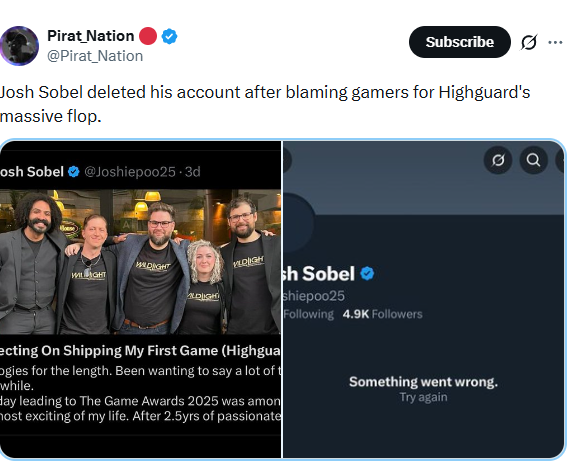
And then came the part that, honestly, made my blood boil. After the layoffs, former lead tech artist Josh Sobel published a lengthy post on X titled "Reflecting on Shipping My First Game." In it, he attributed a significant portion of Highguard's failure to "gamer culture." He pointed to 14,000 negative reviews from users with less than an hour of playtime. He pointed to the "Concord 2" memes. He pointed to content creators who made videos dunking on the game.
Now look. I'm not going to sit here and pretend that every single negative review was fair or that there aren't bad actors in the gaming space who thrive on manufactured outrage. There absolutely are. That's real. But here's where I need to push back, and I'm going to say this as clearly as possible.
1.54 million people tried Highguard in its first month, according to Ampere Analysis. That's not apathy. That's not a boycott. That's a massive audience showing up, trying the product, and deciding it wasn't worth coming back to. That's a product problem. Full stop.
You cannot strongarm people into liking something. You cannot guilt people into sticking around. You cannot blame "gamer culture" for the fact that your 3v3 sweaty team shooter with no public beta, hidden funding, a botched trailer, and a month of radio silence didn't retain players. Players tried it. They gave it a shot. They left because the experience didn't hold up. That is feedback. That is the market speaking.
And you know what makes this even more frustrating? Sobel himself acknowledged that the criticism wasn't entirely unfair. He admitted the game had issues. But then in the same breath, he argued that gamers "put absurd amounts of effort into slandering Highguard." He eventually deleted his X account entirely after the post generated massive backlash.
This is the stuff that drives players up the wall. The cycle is always the same. Studio makes questionable decisions. Game underperforms. Developers blame the audience. The audience gets angrier. And then the next studio that launches a game has to deal with an even more hostile environment. You created this monster. Every time a developer blames the player instead of looking inward, you make it worse for the next team.
The Real Victims Here
And to be honest with you, the people I feel worst for in all of this are the rank-and-file developers who lost their jobs. These weren't the people making the strategic calls. These were artists, engineers, designers. People who, by most accounts, loved working at Wildlight. The Bloomberg report described the studio as a "healthy, collaborative, transparent environment" that many employees loved, at least until the final two months when morale collapsed and leadership couldn't give straight answers about what success would look like.
Wildlight even had a profit-sharing program. A lot of these developers left comfortable jobs at major studios because they believed in this project. They believed they'd be rewarded for building something great. Instead, they got sixteen days of post-launch panic followed by a layoff notice and a small severance check. Many of them, as Sobel himself pointed out, will now be "forced to assimilate back into the actual corporate industry."
That's bad. That's really bad. And it's a direct consequence of leadership decisions, not player behavior. The developers didn't choose to hide the Tencent funding. They didn't choose to skip public testing. They didn't choose to go silent for a month after a poorly received trailer. Those were leadership calls, and the people paying the price are the ones who had no say in them.
What Highguard Should Teach This Industry
Highguard is now officially part of a growing list of live-service shooters that launched and died within weeks. Concord lasted fourteen days. Highguard made it forty-five. The pattern is undeniable at this point.
The live-service hero shooter gold rush is over. It has been over. And studios that are still chasing that dream, still convinced they can be the next Apex Legends or Fortnite or Valorant, need to understand something fundamental. Those games didn't succeed because of their business model. They succeeded because they were genuinely great games that arrived at the right time in the right market conditions. You cannot reverse-engineer that by assembling a team of veterans and throwing Tencent money at the problem.
Is it fun? Is it cool? Those are the two questions that matter. And if your game can't pass that test within the first thirty minutes for a random person jumping in with no mic and no squad, you're done. That's where we're at right now.
Marathon is about to launch. Arc Raiders just went through a major update cycle. The competitive multiplayer space isn't dead. But the margin for error is basically zero. And if the lesson these studios take from Highguard is "gamers are toxic" instead of "we made critical strategic errors at every single decision point," then we're going to be writing this same article again in three months.
I don't want to repeat myself, but I will. The gaming community is not the enemy. The gaming community showed up. Two million of them. They tried the game. They just didn't stay. And until the people making these games start treating that feedback as the incredibly valuable data that it is instead of a personal attack, nothing is going to change.
Share this article
Comments

James Brooke
Founder & Editor
Gaming industry analyst and video editor covering gaming trends, indie games, and industry analysis.
About the author →Related Articles
Bungie Just Cut Half Its Studio. 400 People Gone. What's Even Left?
Over 400 people on a single layoff call. Half the studio. Marathon can't hold an audience. Destiny is over. The studio that made Halo is heading toward extinction and nobody can explain what comes next.

Bungie Just Killed Destiny for a Game Nobody Wanted
Sony paid $3.6 billion. Destiny is dead. Destiny 3 doesn't exist. More layoffs are coming. And the developers who built the franchise are being funneled into a game that 10,000 people play.

Slay the Spire 2 Review Bomb: Stop Telling Consumers What Counts
Three review bombs in two months. 80,000 negative reviews. And the only debate anyone wants to have is whether or not it's fair. We're asking the wrong question.
You May Also Like

Best Games August 2026: 5 Headliners and 5 Under the Radar
Game Freak outside of Pokemon. MGS4 finally on modern hardware. Hell Let Loose Vietnam. A Marvel fighting game from Arc System Works. August is the warm up lap before September destroys everything.
Latest Patch Notes in Gaming — Week of July 20–26, 2026
Battlefield 6 put boats in the game. Heroes of the Storm reworked Ragnaros. 2XKO overhauled its Fuse systems. Phasmophobia rebuilt 13 Willow Street. Ten games patched this week — here's every update.
The Mound: Brilliant Co-Op Mechanic, Rough Execution
The insanity system is unlike anything in co-op horror right now. You can't trust your own screen. But the game around that mechanic needs work. If ACE Team keeps building, something special is underneath.