
Steam Moderation Under Fire: Why Valve Is Right to Keep Its Hands Off Player Reviews
I want to be upfront about something before we get into this. There are going to be parts of this article that some people don't want to hear. That's fine. I'm not here to make everybody comfortable. I'm here to tell you what I actually think, and I think a lot of people are getting this one completely wrong.
The Guardian just published a big piece titled "This shouldn't be normal" where multiple developers spoke out about what they describe as rampant bigotry, harassment, and "anti-woke" review campaigns on Steam. The article paints a picture of a platform overrun with hatred, where developers are helpless victims and Valve is an apathetic landlord collecting rent while the building burns down.
And look, some of what's described in that article is genuinely bad. I'm not going to pretend otherwise. But there's a much bigger conversation being buried underneath the outrage. And it's one that matters a lot more to you as a player than most outlets are willing to admit.
So let me walk you through what's actually going on here, what The Guardian got right, what it got wrong, and why Valve's approach to moderation is one of the last things protecting your ability to speak honestly about the games you spend your money on.
What The Guardian Actually Reported
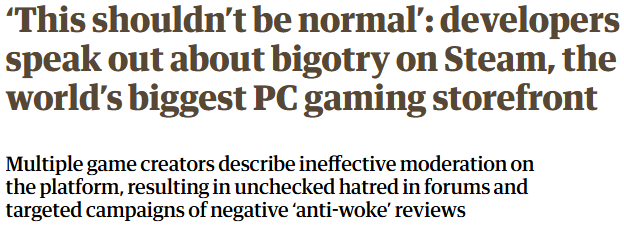
Let's start with the facts, because they matter.
The Guardian interviewed several developers who described negative experiences on Steam. Game designer Nathalie Lawhead reported two reviews on her game that contained antisemitic comments and mocked sexual assault allegations she had publicly made in 2019. She flagged them. Valve's moderators cleared both reviews, meaning they decided the reviews didn't violate policy. Lawhead couldn't re-report them after that. She eventually got one removed by contacting someone she personally knew at Valve, outside the normal moderation process.
Other developers described similar frustrations. A developer identified as Ethan said his game Coven received negative reviews driven by a Steam curator list. Émi Lefèvre, developer of Caravan SandWitch, said Valve's refusal to moderate has turned Steam reviews and forums into a "culture war battleground." A developer called Phi reported transphobic reviews on their game Heart of Enya and was told by Valve to "continue working on the product, while letting the community use the helpfulness feature to surface reviews that they agree with or find to be uninformed."
The article also highlights Steam curator groups like "NO WOKE" and "CharlieTweetsDetected" that organize around flagging games based on perceived political or cultural positions rather than gameplay quality.
That's the report. Now let's talk about it.
Let's Separate the Real Problem From the Manufactured One
I need to be very clear about something. Antisemitic comments in a review are wrong. Mocking someone's sexual assault in a game review is wrong. That's not criticism. That's not consumer feedback. That's just being a terrible person, and those reviews should absolutely be removed.
And here's the thing. Valve's own guidelines already prohibit that. Their rules explicitly cite "insults or harassment," "discrimination," and "public accusations towards others" as violations. So when a review like that gets cleared by a moderator, that's not a policy problem. That's an enforcement problem. There's a difference, and it matters.
But the article doesn't stop at the genuinely indefensible stuff. It keeps going. It folds in negative reviews about LGBTQ+ content. It folds in curator lists that flag games based on political messaging. It folds in players who leave critical reviews based on a game's cultural direction rather than its mechanics.
And that is where I get off the train.
Because what's really being asked for here isn't the removal of harassment. What's being asked for is the removal of opinions the developers don't like. And those are two very different things.
The Uncomfortable Truth Nobody Wants to Say
If a player buys a game and their review says "this game pushes a political agenda I don't agree with," is that harassment? I don't think so. It's a consumer expressing a preference. You might disagree with that preference. I might even disagree with it in specific cases. But a paid customer expressing why they don't recommend a product is what reviews are for.
And to be honest with you, the moment you start drawing lines around which opinions are acceptable in a review and which aren't, you've opened a door that doesn't close. Today it's "you can't criticize our cultural messaging." Tomorrow it's "you can't criticize our monetization." The day after that it's "you can't leave a negative review within the first week of launch because it hurts our visibility algorithm."
We've seen this story before. Every single time a developer or publisher asks for more control over player feedback, it's framed as protecting people. And every single time, what it actually protects is the product from accountability.
That's crazy to me.
What Valve Actually Does (That Nobody Mentions)
Here's what drives me up the wall about the framing of this story. The Guardian piece, and every outlet running with it, makes it sound like Valve does absolutely nothing. Like Steam is some lawless wasteland where anything goes and developers are just left out in the cold.
That is not true. Not even close.
Valve built an off-topic review bomb detection system back in 2019. It monitors review activity in real-time across every game on Steam. When it detects anomalous spikes, it alerts a moderation team who investigates. If the reviews are determined to be off-topic, they're flagged and removed from the review score calculation. The reviews stay up, but they don't tank the game's rating. Players can even choose whether or not to include flagged reviews in the scores they see.
Beyond that, developers can flag individual reviews for moderation. They can respond to reviews directly with a visible developer response. They can moderate their own forums. They can hire additional moderators for their discussion boards. Players can mark reviews as helpful or unhelpful, which directly affects visibility.
Are these systems perfect? No. Clearly some stuff slips through that shouldn't, like the antisemitic reviews Lawhead described. But the idea that Valve just shrugs and walks away is a narrative, not a reality.
And I'm going to say that again as clearly as possible. The tools exist. The systems exist. The enforcement isn't always perfect, and that's a fair criticism. But the solution being proposed, which is Valve becoming the arbiter of which political opinions are acceptable in game reviews, that is not a fix. That's a different problem entirely.
The Real Issue: Who Gets to Define "Off-Topic"?
This is where things get really interesting, and where I think a lot of people are going to disagree with me. That's fine.
The Guardian article references the "NO WOKE" curator and similar groups as a core part of the problem. These are curators who flag games based on perceived political messaging. The article frames them as engines of harassment.
But here's what I want you to think about. A curator list is an opt-in feature. You choose to follow a curator. If you don't follow them, you never see their reviews on a game's store page. They're not forced onto anyone. The system is designed to let people curate their own experience, and that includes curating based on values and preferences that you and I might not share.
Is it annoying when someone leaves a review that says "too woke" with no elaboration? Sure. Is it helpful? Not particularly. But Steam has 42 million concurrent users. The review helpfulness system is specifically designed to surface useful reviews and bury low-effort ones. The system works. Not perfectly, but it works.
The alternative, Valve manually reviewing curator lists and deciding which political viewpoints are acceptable to organize around, is something that should terrify every single person who cares about open platforms. Because the people asking for that power today might not be the ones wielding it tomorrow.
Follow the Money. It Always Tells the Story.
And you know what makes this entire thing that much more interesting? Let's look at the numbers.
Steam generated an estimated $16.2 billion in total revenue in 2025. That's up 5.7% from 2024. Valve itself pocketed over $4 billion from its commission cut. The platform hit 42 million concurrent users in January 2026. A new record. Steam reportedly pulled in $1.6 billion in December alone.
Those are not the numbers of a broken platform. Those are not the numbers of a marketplace that players are fleeing because of toxic reviews. Those are the numbers of a platform that 42 million people choose to use simultaneously because, despite its flaws, it works better than anything else out there.
Now compare that to the Epic Games Store, which offers an 88/12 revenue split instead of Steam's 70/30. Epic has nearly 300 million registered accounts. But they captured only about 3% of third-party revenue in 2024. Most people use Epic to claim free games and play Fortnite. That's it. Steam's users are paying customers. They come back because the platform respects them enough to let them speak.
That tells you everything you need to know about what players actually value.
The Pattern We Keep Seeing
I don't want to repeat myself, but this fits into something I've been talking about for a while now. There is a growing pattern in the gaming industry where developers, publishers, and certain media outlets want to reframe legitimate consumer feedback as toxicity. We saw it with Highguard. We saw it with the Concord discourse. We see it every time a game underperforms and the first instinct is to blame the audience rather than examine the product.
And here's the thing. I'm not saying all negative reviews are helpful. I'm not saying forums are a utopia of measured discourse. They're not. Anybody who has spent five minutes in any online community knows that. But the answer to messy, imperfect free expression is not corporate censorship. It never has been.
Valve, for all its faults (and there are many, trust me, I'll get to the antitrust lawsuits another day), has maintained one of the last major platforms where players can actually speak freely about the products they buy. In a world where every other platform is racing to control the narrative, that matters.
What Actually Needs to Happen
So what do I actually want here? Because I'm not saying everything is fine and nothing needs to change.
Valve needs to enforce the rules it already has. When a review contains antisemitic slurs, that violates the existing guidelines. Remove it. When a review mocks someone's sexual assault, that violates the existing guidelines. Remove it. Don't clear it and call it a day.
The moderation team needs to be bigger. Valve employs fewer than 400 people and processes hundreds of thousands of tickets weekly. The company makes $4 billion a year from Steam. You can afford more moderators. That's not a culture war position. That's just math.
But the line needs to stay exactly where it is when it comes to opinions about games. A player who says "I didn't enjoy this game because I felt the story prioritized a political message over gameplay" is not engaging in bigotry. They're engaging in criticism. And the moment Valve starts policing that, they stop being a marketplace and start being a publisher with editorial control over what customers are allowed to think about products.
And that would be the end of what makes Steam, Steam.
The Bigger Picture
There are a lot of people right now, on both sides of this argument, who are very loud and very certain they're right. I get that. This is an emotional topic.
But I need you to take a step back and think about what's actually at stake here. The question isn't "should people be mean on the internet?" Obviously not. The question is "who gets to decide what counts as acceptable feedback on the largest PC gaming platform in the world?"
And right now, the answer is: the players decide, through helpfulness votes, curator follows, and purchasing decisions. It's imperfect. It's messy. Sometimes it's ugly. But it's yours.
The moment that power shifts to developers, publishers, or media pressure campaigns, it stops being yours. And in an industry that has spent the last decade teaching players that their feedback doesn't matter, that their wallets are the only language companies understand, that consequences are the only thing that moves the needle, I am not about to celebrate handing over the one tool players have left on the one platform that still lets them use it.
We'll see how this plays out. Valve hasn't commented publicly, which is completely on-brand for a company that treats silence like a core philosophy. But if history is any guide, they'll keep doing what they've always done. Let the noise happen, make quiet improvements to the systems, and let the platform keep growing.
And honestly? That might be exactly the right call.
Share this article
Comments

James Brooke
Founder & Editor
Gaming industry analyst and video editor covering gaming trends, indie games, and industry analysis.
About the author →Related Articles

Sony Is Killing Physical Games. Their Own Studio Just Trolled Them About It.
170,000 signatures. Six days of silence. Dominoes making memes. And Insomniac publicly confirming Wolverine gets a real disc while the parent company kills the format. Sony's silence is the statement.

Best Games Coming in July 2026: 5 Headliners and 5 Under the Radar
Two massive remakes drop on the same day. A DOOM expansion. A Splatoon game nobody expected. And enough indie picks to fill the gaps before September obliterates your wallet. Here's what's worth playing in July.
Gaming's Bloody Summer Starts Tomorrow. Xbox Isn't the Only One Cutting.
Microsoft's fiscal year ends tonight. The cuts start tomorrow. And it's not just Xbox. Sony, EA, and BioWare are all expected to face closures in July. Here's what we know heading into the bloodiest summer the gaming industry has seen.
You May Also Like

Moonlight Peaks Is a Vampire Farming Sim That Just Launched to 87% Positive on Steam. For $35.
You play as Dracula's kid who ran away from home to start a farm. You sleep in a coffin. You water crops with magic spells. 87% positive on Steam in two days. $34.99 and no nonsense.
Hunger: The Extraction RPG That Might Finally Get It Right
The team that built Hell Let Loose is back with something completely different. Hunger is an extraction RPG set in Napoleonic Europe and from everything I've seen in the playtest it already looks ready for early access.

Latest Patch Notes in Gaming — Week of June 29 – July 5, 2026
Diablo IV launched its biggest season yet. Overwatch let the community redesign every hero. The Sims 4 overhauled autonomy. Nine games patched on a single day. Ten games total — here's every update.