

Gaming's $195 Billion Problem: Record Revenue, 44,000 Jobs Lost, and an Industry at War With Itself
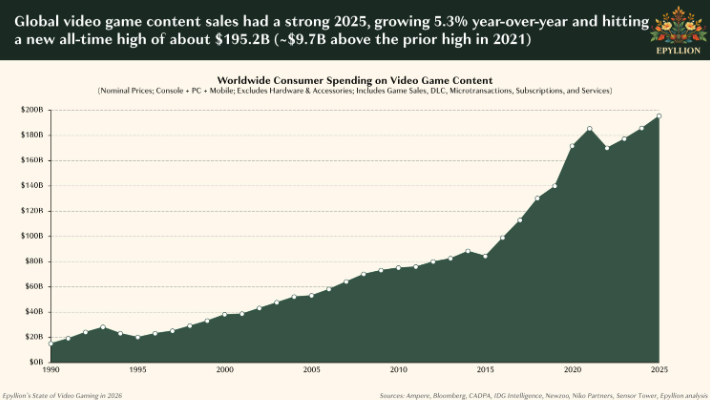
$195.6 billion.
That's how much the global gaming industry made in content revenue in 2025. The highest number ever recorded. According to Matthew Ball's State of Video Gaming 2026 report from Epyllion, the industry posted its third consecutive year of revenue growth. More money than film. More money than music. More money than streaming. Combined.
44,000.
That's how many people lost their jobs making the products that generated that revenue. Over four years. Rolling layoffs that started in 2022 and haven't stopped. Not during record-breaking quarters. Not during billion-dollar launches. Not during any of it.
Those two numbers tell you everything you need to know about the gaming industry in 2026. And the fact that they exist in the same sentence is the most damning indictment of corporate gaming I've ever written.
The Numbers Don't Make Sense. That's the Point.
Let me lay this out because every time I think I've found the most absurd stat, I find a worse one.
GTA Online generates approximately $1.3 million per day. That's $500 million a year. From a game that launched in 2013. Fortnite is on track for roughly $6 billion in 2026. Six billion. From a single free-to-play game.
EA's Battlefield 6 became the best-selling game of 2025. The franchise posted its highest-ever sales figures. EA laid off the Battlefield team anyway.
Epic Games raised Fortnite's prices, then fired over 1,000 people. 23% of the company. Gone.
Sony shut down Bluepoint Games. The studio that made the Demon's Souls remake. One of the most critically acclaimed remakes in PlayStation history. Closed.
Microsoft spent $69 billion acquiring Activision Blizzard. The largest gaming acquisition in history. Then spent the next two years laying off thousands of people across the combined company.
These aren't struggling companies making hard decisions. These are the most profitable entertainment companies on the planet making choices that have nothing to do with survival and everything to do with margins.
The Layoff Timeline Is Relentless
I want to put the full scope of this in front of you because the individual stories make it easy to lose the pattern. When you see one studio close, it feels like an isolated tragedy. When you see the full timeline, it feels like an industry wide strategy.
2022 saw roughly 8,500 jobs lost. The first wave of post-pandemic correction as studios unwound the aggressive hiring sprees of 2020 and 2021.
2023 escalated to approximately 10,500. Restructuring accelerated across major publishers. Embracer Group's house of cards collapsed after a failed $2 billion Saudi deal, reducing their headcount from 15,700 to 7,800. That's roughly 8,000 people from one company.
2024 was the peak. Over 14,600 jobs lost. Microsoft Gaming, Sony, EA, Ubisoft, Unity, Riot Games, Take-Two, Bungie. The layoffs touched every major publisher and dozens of smaller studios. Studios that had been open for decades closed in a single press release.
2025 came in at roughly 9,200. Down from 2024's peak but still devastating. EA closed Cliffhanger Games and cancelled the Black Panther game. More Ubisoft restructuring. More closures.
2026 has already logged 2,000 to 3,000 additional losses and we're only five months in. Epic's 1,000-person cut in March. Iron Galaxy's 90 in April. The Ashes of Creation implosion taking 210 people with it. And the year is far from over.
That's 44,000 people. Artists. Engineers. Designers. Writers. QA testers. Community managers. People who spent years building the games that generated $195.6 billion in revenue. Shown the door because a spreadsheet said their salary was a line item that could be optimized.
Where the Money Actually Goes
Here's the question nobody in corporate gaming wants to answer. If the industry is making more money than ever, where is it going?
It's not going to the people who make the games. 44,000 of them lost their jobs. The ones who remain are working longer hours with smaller teams. The Skillsearch survey we covered showed that only 27% of developers who found new jobs after being laid off feel secure in those positions.
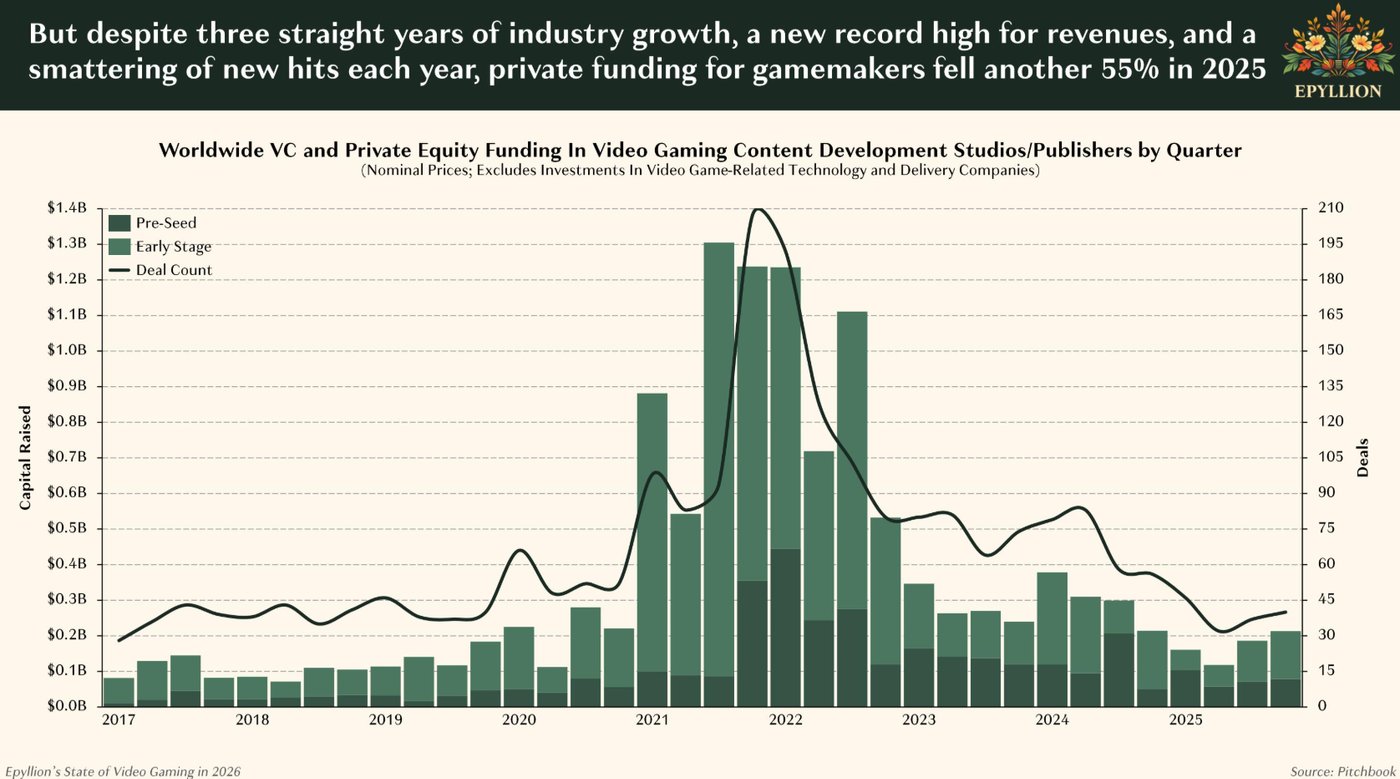
It's not going to new games. Private investment in gaming dropped 55% in 2025 according to Epyllion. Publishers are greenlighting fewer projects. Taking fewer risks. Funneling resources into the live-service games that already print money instead of investing in the next generation of original titles.
It's going to shareholders. It's going to executive compensation. It's going to stock buybacks and quarterly earnings reports that use layoffs as a signal of "fiscal discipline" to investors who have never played a video game. On Wall Street, the pattern has been documented repeatedly. Stock prices rise after layoff announcements. The market rewards companies for cutting the people who build their products. That's not an accident. That's the incentive structure working exactly as designed.
And it's going to acquisitions. $69 billion for Activision. $3.6 billion for Bungie. Billions more across dozens of deals. Companies buying other companies, absorbing their talent, stripping them for parts, and closing what's left when the numbers don't hit projections that were never realistic in the first place.
The Live-Service Trap
There's a deeper structural problem underneath the layoff crisis that doesn't get talked about enough. The revenue isn't just concentrated at the top. It's concentrated in a specific type of game.
Fortnite. GTA Online. Genshin Impact. Roblox. A handful of live-service games generate a disproportionate share of the industry's total revenue. And every publisher who sees those numbers tries to build their own version. The problem is that the live-service market doesn't have room for dozens of winners. It barely has room for five.
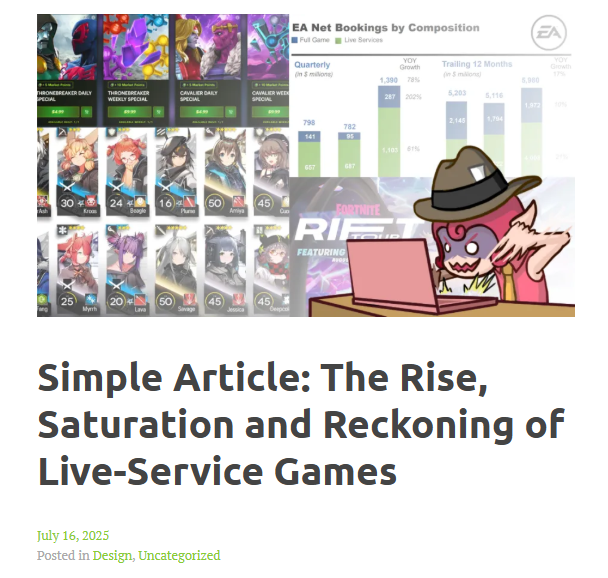
Sony's Concord shut down within two weeks of launch. Hyenas was cancelled before it shipped. XDefiant lasted eight months. The list of failed live-service attempts is longer than the list of successes by an order of magnitude. And every one of those failures cost hundreds of millions of dollars and hundreds of jobs.
The industry keeps chasing the Fortnite model because the math looks irresistible on a slide deck. Recurring revenue. Engagement metrics. Lifetime player value. But the math only works if your game becomes one of the five that survive. And the odds of that are roughly the same as winning the lottery, except the lottery ticket costs $200 million and requires 500 people to buy it.
The Brain Drain Is Already Here
We covered this a few weeks ago but it bears repeating in this context. 44% of game developers are considering leaving the industry. 76% in the UK. 74% of students are afraid to enter it. The pipeline of talent flowing into gaming is shrinking at both ends. Experienced developers are leaving because they can't trust the stability. New developers aren't entering because they can see the wreckage from the outside.
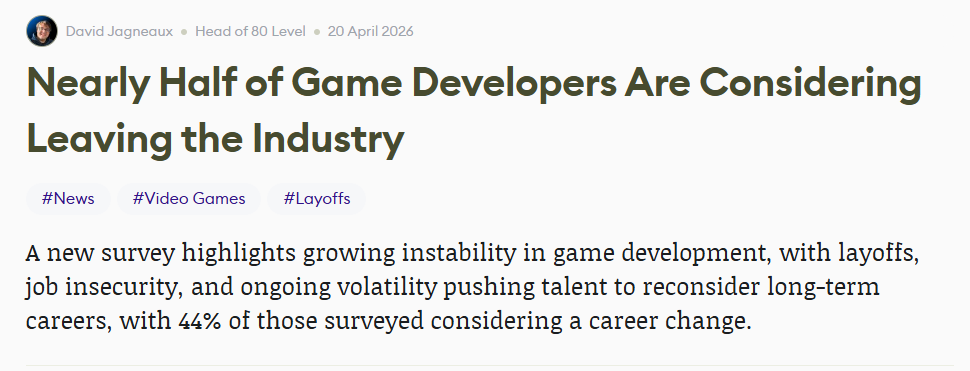
John Romero said it best. "We were there in the '80s for the crash, and this is definitely crashier."
The difference between the crash of 1983 and what's happening now is that in 1983, the market stopped wanting games. In 2026, the market wants games more than ever. The demand is at an all-time high. The revenue proves it. The crash isn't happening because players stopped showing up. It's happening because the industry decided that the people who make the games are the most expendable part of the equation.
The Indie Counter-Narrative
And here's the part that makes all of this even more infuriating. While AAA publishers are laying off thousands and shipping broken $70 games, the indie side of the industry is thriving.
Schedule I. One developer. $20. Eight million copies sold.
Slay the Spire 2 outsold Crimson Desert on the Steam charts.
Road to Vostok. One developer. $15. Very Positive reviews.
Soulmask just hit 1.0 and gave existing owners a full expansion for free.
Far Far West launched this week at $20 with 97% Overwhelmingly Positive reviews.
These games aren't succeeding in spite of the industry crisis. They're succeeding because of it. Players are migrating toward smaller games that respect their time and money. Developers who get laid off from AAA studios are starting indie projects because the alternative is re-entering a system that will lay them off again in 18 months. The talent that AAA is discarding is becoming the competition that AAA can't beat.
The pendulum isn't just swinging. It's accelerating. And every layoff, every studio closure, every broken launch at $70 pushes it further.

What This Actually Means
I'm not going to pretend there's a simple fix for this. The structural incentives that created this crisis are deeply embedded. Public companies answer to shareholders. Shareholders want returns. Returns come from cutting costs. The easiest cost to cut is people.
But I want to be clear about what this moment represents. The gaming industry just posted $195.6 billion in revenue. The highest number in the history of entertainment media. And in the same breath, it eliminated 44,000 jobs, scared 74% of students away from the profession, and drove 44% of its remaining workforce to consider leaving entirely.
That's not a correction. That's not a market adjustment. That's not a necessary restructuring.
That's an industry eating itself.
The games are still being made. The money is still being generated. The players are still showing up. But the people who build the thing that makes all of it possible are being treated as disposable. And at some point, the consequences of that will show up in the product. In the quality. In the innovation. In the ambition.
It won't happen overnight. It'll happen the way it always happens. Death by a thousand cuts. One fewer senior engineer on the team. One fewer QA pass before launch. One fewer original pitch that gets greenlit because the safe sequel is less risky. Slowly, steadily, until the games start feeling off and nobody can explain why.
Except we can explain why. We're watching it happen right now. In real time. At a scale the industry has never seen.
$195.6 billion. 44,000 jobs.
Those numbers tell you everything. And that's where we're at right now.
Sources:
Epyllion State of Video Gaming 2026 Report (Matthew Ball) - $195.6B revenue figure, private investment decline, layoff totals by year
GDC 2026 State of the Game Industry Report - 33% of US devs laid off, 48% still looking for work, 74% of students concerned about entering the industry, 62% interested in unions Skillsearch Games & Immersive Salary & Satisfaction Report 2026 - 44% considering leaving the industry, 76% in the UK, 55% of laid-off devs haven't found work, AI sentiment data
Skillsearch 2026 Report (PDF direct download) 026.pdf
Wikipedia: 2022-2026 Video Game Industry Layoffs - Comprehensive layoff timeline, studio closures, company-by-company breakdown
Game Rant: Every Video Game Layoff and Studio Closure in 2026 So Far - Running tracker of 2026 layoffs specifically
GamingLayoffs.com - Real-time layoff tracker with company data
Share this article
Comments

James Brooke
Founder & Editor
Gaming industry analyst and video editor covering gaming trends, indie games, and industry analysis.
About the author →Related Articles
Best Games of 2026 So Far: Where Your Money Is Actually Worth Spending
NPR published their half year list and it read like a Metacritic scroll. This is a real one. 12 games from $6 to $70 that actually earned your money in the first half of 2026.
Palworld 1.0 Is Here. The Price Didn't Go Up. And the Game That Wasn't Supposed to Work Just Hit 40 Million Players.
The concept sounded ridiculous. Pokemon with guns. The internet argued over whether it should even exist. And now it has 40 million players, an Overwhelmingly Positive Steam rating, and the price didn't go up for the full release.
Xbox Just Cut 3,200 Jobs. Three Days Later the CEO Is Advising the Federal Reserve.
3,200 jobs cut. The internal memo published on Twitter. 64 cents lost on every dollar invested. 14 layers of management. And three days later the CEO who did it all is advising the Federal Reserve on jobs. You cannot make this up.
You May Also Like

Best Games August 2026: 5 Headliners and 5 Under the Radar
Game Freak outside of Pokemon. MGS4 finally on modern hardware. Hell Let Loose Vietnam. A Marvel fighting game from Arc System Works. August is the warm up lap before September destroys everything.
Latest Patch Notes in Gaming — Week of July 20–26, 2026
Battlefield 6 put boats in the game. Heroes of the Storm reworked Ragnaros. 2XKO overhauled its Fuse systems. Phasmophobia rebuilt 13 Willow Street. Ten games patched this week — here's every update.
The Mound: Brilliant Co-Op Mechanic, Rough Execution
The insanity system is unlike anything in co-op horror right now. You can't trust your own screen. But the game around that mechanic needs work. If ACE Team keeps building, something special is underneath.