

Gaming Industry Talent Exodus: 44% of Developers Want Out

A month ago, I wrote about the GDC 2026 report that found one-third of US game developers had been laid off in the past two years. The numbers were devastating. 33% of the American workforce, gone. 74% of students afraid to enter the industry. 82% of developers wanting unions. I called it a self-inflicted crisis, because that's what it was.
And now we have the follow-up. And it's worse.
Skillsearch, a gaming industry recruitment firm, just released their 2026 Salary and Satisfaction survey. Over 1,000 game industry professionals across Europe, North America, the UK, Asia-Pacific, and the Middle East. And the headline number is this.
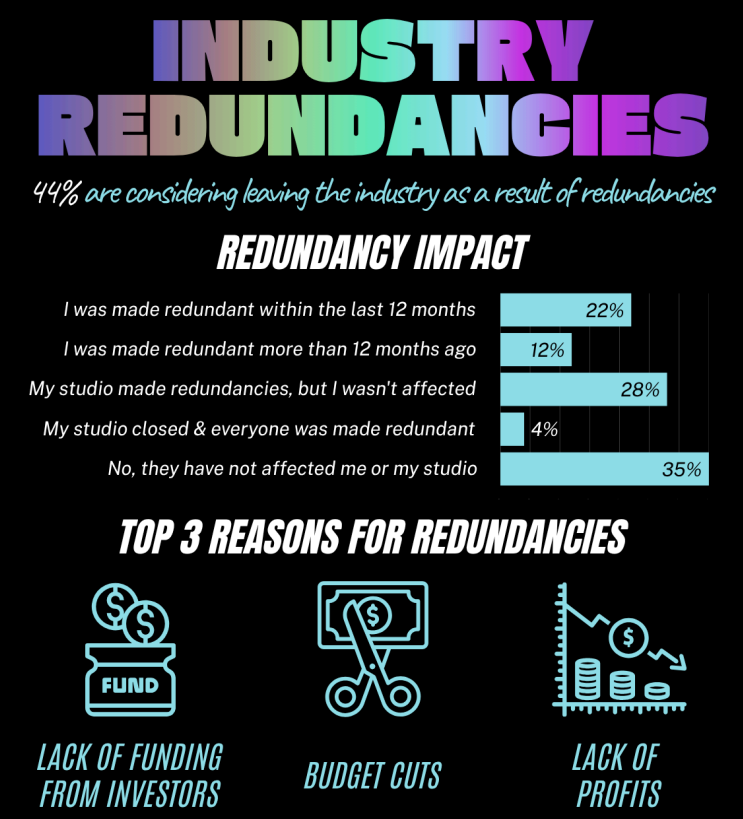
44% of respondents are considering leaving the gaming industry entirely.
Not switching studios. Not taking a break. Leaving. Walking away from the industry altogether because they've watched it eat its own people for four straight years and they don't trust it to stop.
That's not a labor market correction. That's a talent exodus. And the industry is not prepared for what happens when these people actually leave.
The Numbers Are Brutal
Let me walk you through the data because every single line of this survey makes the picture worse.
22% of respondents were laid off within the last 12 months. Another 12% had been laid off more than a year ago. 28% watched their studios go through layoffs even if they personally kept their jobs. Only 35% said their teams had not been affected by layoffs at all.
That means roughly two-thirds of the people making games right now have either been directly hit by layoffs or have watched their colleagues get walked out the door. Two-thirds.
And here's the part that should terrify every executive in every boardroom. Of those who were laid off, only 45% managed to find a new job in the gaming industry. Only 45%. And of those who did find work, just 27% feel secure in their new roles.
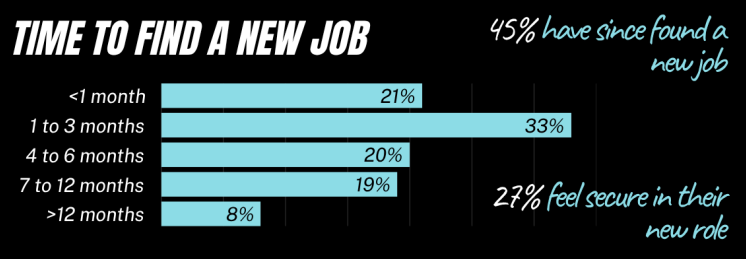
Let me translate that into normal human language. If you get laid off from a game studio right now, there's a better than coin-flip chance you won't find another job in gaming at all. And if you do land somewhere, there's a 73% chance you're sitting at your new desk wondering when the next round of cuts is coming.
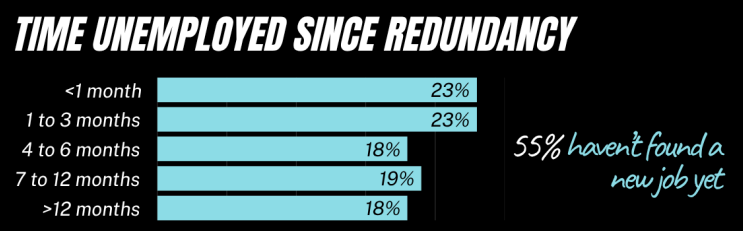
55% of laid-off developers have not found a new position. That's the majority. The majority of people who lost their jobs making video games have not been able to find new ones.
So when 44% of the total workforce says they're thinking about getting out? That's not pessimism. That's math.
The UK Numbers Are Alarming
The global picture is bad. The UK picture is a crisis.
76% of UK-based respondents said they are either planning to leave or actively considering leaving the gaming industry by the end of 2026. Seventy-six percent. In one of the most celebrated game development hubs on the planet.
The UK has been home to studios like Rocksteady, Rare, Media Molecule, Ninja Theory, Playground Games. It's been a cornerstone of global game development for decades. And three-quarters of its developers are looking at the exit.
The reasons aren't complicated. Studio closures. Reduced funding. A slowdown in new projects getting approved. The cost of living in London and other major UK cities combined with an industry that can't guarantee you'll have a paycheck in six months. The math stops working. And when the math stops working, people stop staying.
The AI Fear Is Real
The survey also dug into AI sentiment and the results line up with what the GDC report showed, but with sharper edges.
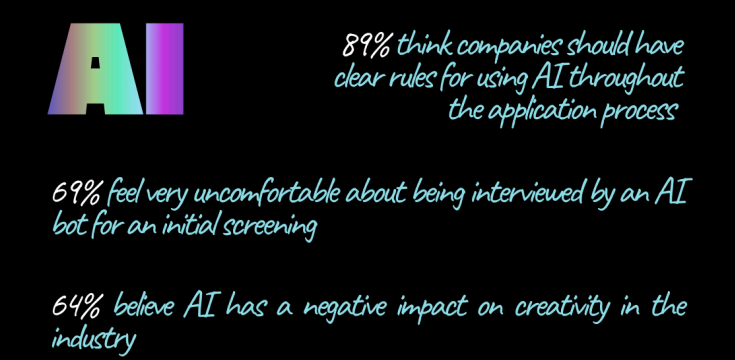
52% of respondents already use AI tools in their work. That's more than half the industry. But 64% believe AI is having a negative impact on creativity. And nearly half think AI adoption could eventually lead to their dismissal.
Only 29% said their employers had introduced clear rules for AI usage.
So the situation is this. More than half the industry is using AI. Nearly half think it's going to cost them their jobs. Almost nobody's employer has bothered to set guidelines for how it's being used. And the people at the top keep talking about AI as a cost-saving measure while simultaneously laying off the humans it's supposedly augmenting.
I've said it before and I'll say it again. The problem isn't the tool. It's the people making the decisions about how to deploy it. And when executives see AI as a justification to cut headcount rather than a way to empower their existing teams, this is what you get. A workforce that doesn't trust the technology because they don't trust the people wielding it.
The Brain Drain Nobody's Talking About
Here's what keeps getting missed in the coverage of these surveys. Everyone focuses on the people getting laid off. And they should. Those stories are devastating and those people deserve better.
But the longer-term damage is happening to the people who stay.
When a studio goes through layoffs, the survivors don't just move on. They absorb the workload of the people who left. They watch colleagues they've worked with for years get walked out with a LinkedIn post and a severance check. They update their resumes. They start networking. They stop caring about the project they're on because they know the next round could come at any time.
And critically, the most experienced, most talented, most employable people are the first ones out the door. Not because they get laid off first. Because they have options. They're the ones who can leave. The senior engineers, the veteran designers, the art directors with 15 years of experience. They look at this industry, they look at the stability and the pay they could get in fintech or enterprise software or literally any other tech sector, and they make the rational decision.
The people who stay are disproportionately the ones who can't leave yet. The ones earlier in their careers. The ones without the portfolio to jump to another sector. The ones who love games so much they're willing to endure conditions that would be unacceptable in any other industry.
And that's the trap. The industry has been exploiting passion as a labor subsidy for decades. "You're lucky to work in games." "People would kill for your job." "This is a dream industry." Those phrases have been used to justify below-market pay, mandatory crunch, and now a rolling cycle of mass layoffs that the GDC report showed has hit one-third of the American workforce.
At some point, passion runs out. And 44% of the industry is telling you that point is now.
What This Actually Means for Players
I know some people are reading this thinking, "That's sad for the developers, but what does it mean for me?"
It means your games are going to get worse.
Not immediately. Not all at once. But slowly. Steadily. The way quality always degrades when you hollow out the workforce that builds the product. When a studio loses its senior talent, the institutional knowledge walks out the door with them. The people who know why the engine works the way it does. The people who know which design decisions failed in the last project. The people who mentor the junior devs who will someday replace them.
Except now those junior devs aren't being replaced either, because 74% of students are afraid to enter the industry in the first place.
This is a pipeline problem. And pipeline problems don't show up in quarterly earnings reports. They show up three years later when the games start feeling off. When sequels feel hollow. When the polish isn't there. When the innovation slows down. When the industry starts shipping the same game over and over because nobody's left who remembers how to take a creative risk.
Death by a thousand cuts. Except the industry is holding the knife.
The Pattern Is Undeniable
The GDC report said 33% of US devs were laid off. The Skillsearch survey says 44% of the global workforce wants out. Iron Galaxy just laid off 90 people three days ago, their second round in two years. Epic fired over 1,000 people after raising Fortnite prices. Sony shut down Bluepoint. Ubisoft is on a rolling layoff streak with no end in sight.
And through all of it, the same pattern. Record revenues. Record-breaking game sales. And layoffs anyway. Because the layoffs were never about survival. They were about margins. They were about stock price. They were about making the quarterly numbers look good for investors who have never played a video game in their lives.
The industry didn't just create a labor crisis. It created a trust crisis. And trust, once broken at this scale, doesn't come back with a hiring spree and a LinkedIn post about "exciting opportunities."
John Romero said it best last month. "We were there in the '80s for the crash, and this is definitely crashier."
He's right. And the crash this time isn't coming from a market that doesn't want games. The market wants games more than ever. The crash is coming from an industry that's systematically destroying its ability to make them.
That's where we're at right now. And I don't like any of this.
Share this article
Comments

James Brooke
Founder & Editor
Gaming industry analyst and video editor covering gaming trends, indie games, and industry analysis.
About the author →Related Articles
Best Games of 2026 So Far: Where Your Money Is Actually Worth Spending
NPR published their half year list and it read like a Metacritic scroll. This is a real one. 12 games from $6 to $70 that actually earned your money in the first half of 2026.
Palworld 1.0 Is Here. The Price Didn't Go Up. And the Game That Wasn't Supposed to Work Just Hit 40 Million Players.
The concept sounded ridiculous. Pokemon with guns. The internet argued over whether it should even exist. And now it has 40 million players, an Overwhelmingly Positive Steam rating, and the price didn't go up for the full release.
Xbox Just Cut 3,200 Jobs. Three Days Later the CEO Is Advising the Federal Reserve.
3,200 jobs cut. The internal memo published on Twitter. 64 cents lost on every dollar invested. 14 layers of management. And three days later the CEO who did it all is advising the Federal Reserve on jobs. You cannot make this up.
You May Also Like

Best Games August 2026: 5 Headliners and 5 Under the Radar
Game Freak outside of Pokemon. MGS4 finally on modern hardware. Hell Let Loose Vietnam. A Marvel fighting game from Arc System Works. August is the warm up lap before September destroys everything.
Latest Patch Notes in Gaming — Week of July 20–26, 2026
Battlefield 6 put boats in the game. Heroes of the Storm reworked Ragnaros. 2XKO overhauled its Fuse systems. Phasmophobia rebuilt 13 Willow Street. Ten games patched this week — here's every update.
The Mound: Brilliant Co-Op Mechanic, Rough Execution
The insanity system is unlike anything in co-op horror right now. You can't trust your own screen. But the game around that mechanic needs work. If ACE Team keeps building, something special is underneath.