
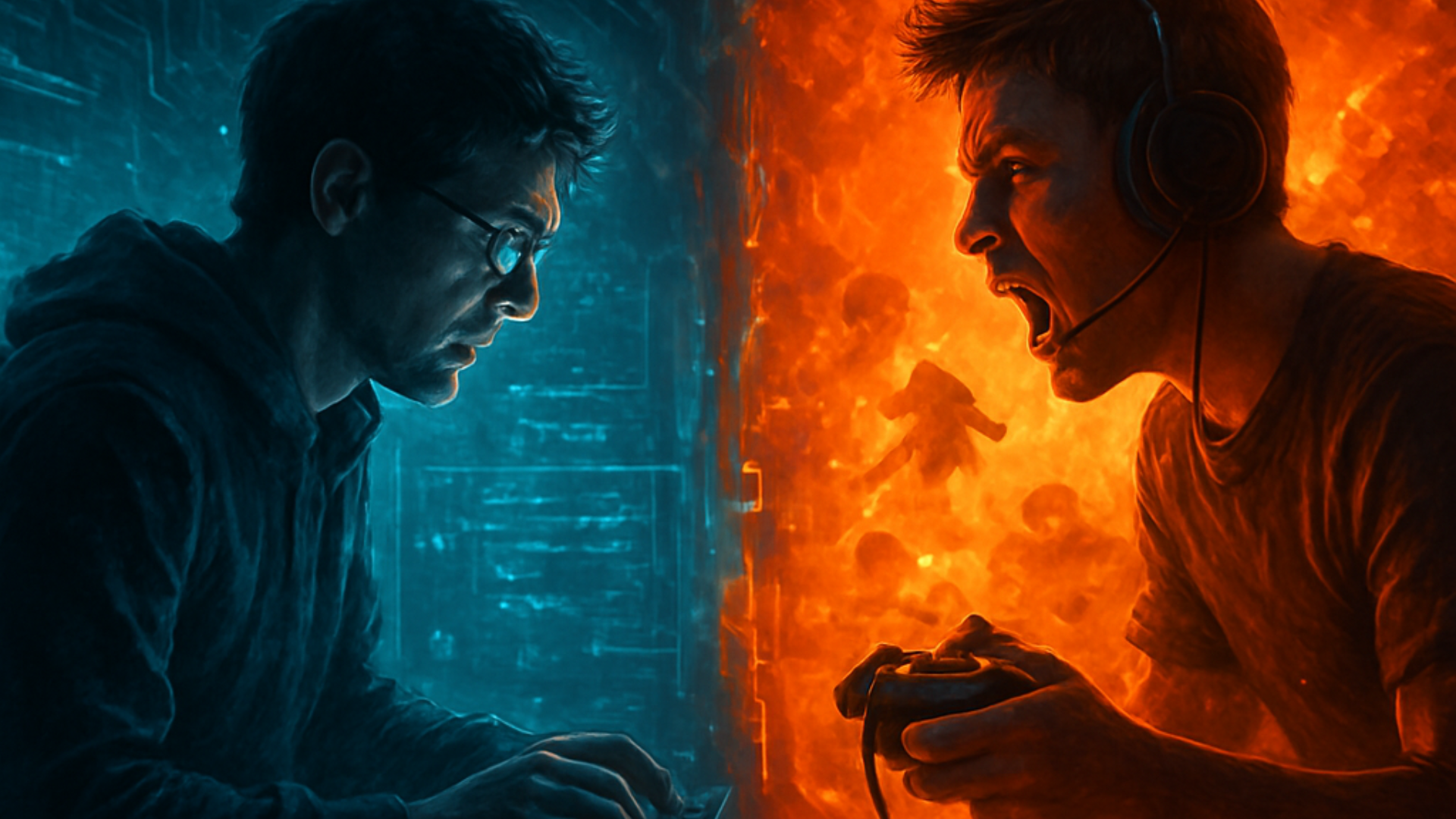
Developers vs. Gamers: The Gaming Industry Created This Fight and Doesn't Want to Admit It
Developers vs. Gamers: The Gaming Industry Created This Fight and Doesn't Want to Admit It
I am so sick and tired of this narrative.
Every few weeks, like clockwork, another developer ships a game that doesn't land, watches the player count crater, and then takes to social media to tell us that we're the problem. That gamers are too mean. That the community is toxic. That content creators manufactured the negativity. That the discourse is what killed their game, not the game itself.
And look, I'll be honest with you. There is a part of me, a small part, that wants to show some sympathy. Making games is hard. I know that. Losing your job over a project you poured years into is devastating, and I would never try to minimize that pain. But then I snap out of it. Because this conversation keeps getting framed in a way that completely ignores how we got here. And that framing? That's the part that drives me up the wall.
So today, I want to lay this whole thing out. The developer vs. consumer war that everyone keeps talking about. Where it started, why it's gotten worse, and why the gaming industry needs to stop pointing the finger at the people keeping the lights on.
The Highguard Situation Is Just the Latest Example
Let's start with the most recent one, because it perfectly captures everything wrong with this dynamic.
Highguard, the free-to-play hero shooter from Wildlight Entertainment, launched in January 2026. The team behind it included former Apex Legends and Titanfall developers. On paper, this thing should have had momentum. In reality, it didn't.
The game was revealed at The Game Awards 2025 and was met with immediate skepticism from the community. Within days, comments sections were flooded. Review scores tanked. And by February, Wildlight announced sweeping layoffs.
And here's the thing. Instead of looking inward, former Lead Tech Artist Josh Sobel published a lengthy post on X blaming gamers and content creators for the game's failure. He said Highguard received over 14,000 review bombs from users with less than an hour of playtime. He accused content creators of leaning into negativity because it gets more engagement. He said players put "absurd amounts of effort into slandering Highguard."
And you know what makes this entire thing that much more frustrating? The game had nearly 100,000 concurrent players at launch. People did show up. They tried it. And they left. That's not slander. That's feedback.
Sobel eventually deleted the post. Then he deleted his entire account. And the conversation moved on to the next thing. But the damage was done, and the pattern repeated itself again.
We've Seen This Story Before
Highguard is not an isolated case. This is a pattern. A well-worn, exhausting pattern.
Concord. Remember Concord? Sony's hero shooter that launched in August 2024, peaked at fewer than 700 concurrent Steam players, and was pulled offline in two weeks. Two weeks. Reports suggested development costs somewhere between $200 million and $400 million. And what happened after it collapsed? Developers took to social media to express frustration that gamers were being too harsh. One developer was quoted calling gamers "talentless freaks." That tells you everything you need to know about the disconnect.
The game had an eight-year development cycle. It launched as a $40 product in a genre completely dominated by free-to-play competitors. Its character designs didn't resonate with the audience. Its marketing was nearly nonexistent. And when it failed, the reflex was to blame the consumer. Not the strategy. Not the pricing. Not the market research that should have raised every red flag imaginable.
Then there's Ubisoft. These guys have turned consumer antagonism into an art form. When Assassin's Creed Shadows was met with backlash, CEO Yves Guillemot called the criticism "malicious" and "hateful." Internally, Ubisoft produced a presentation framing the whole thing as a "battle" they needed to win against "the loudest haters." Their strategy was literally to "stop focusing on those who hated us" and "fire up our allies."
I'm going to say that again as clearly as possible. A multi-billion dollar corporation described its relationship with its own consumer base as a battle. And somehow, we're the ones being told we're the problem.
But Here's Why the Industry Is Actually Angry
Let me translate what's really going on here, because it's not complicated.
For the better part of two decades, the gaming industry operated on a simple formula. Hype the product. Control the narrative. Launch to massive first-week sales. Move on. Repeat.
That formula doesn't work anymore. And it doesn't work because players got wise to it.
We got burned by broken launches. We got burned by games that looked incredible in trailers and played like tech demos at launch. We got burned by Cyberpunk 2077. By Battlefield 2042. By Anthem. By Marvel's Avengers. By Suicide Squad. By every single game that promised the world and delivered a fraction of it.
Death by a thousand cuts. That's what the last decade of AAA gaming has been for consumers. And now, when we show up to a game reveal and our first reaction is skepticism instead of blind hype? That's not toxicity. That's pattern recognition.
The industry didn't just lose our trust. It trained us to be distrustful. You cannot spend years shipping unfinished products, charging more for less, and then act surprised when the audience stops giving you the benefit of the doubt.
You created this. Not us.
The Numbers Tell the Real Story
Let's talk about what's actually happening in this industry, because the scale of it is insane to me.
According to the 2026 GDC State of the Game Industry Report, one-third of all U.S. gaming workers were laid off in the past two years. One-third. That means if you had three friends working in gaming two years ago, statistically one of them lost their job.
At AAA studios specifically, two-thirds of respondents said their company conducted layoffs in the past year. Microsoft alone slashed over 9,000 gaming positions while simultaneously boasting about "record performance." That is just insane to me. Record revenue and record layoffs at the same time. Let that sink in.
Meanwhile, the cost of everything has gone up. Eight separate price hikes on hardware, accessories, and subscriptions in 2025 alone. Games are $70 now. Some are $80. Nintendo launched Mario Kart World at $80. Microsoft tried to push The Outer Worlds 2 to $80 before walking it back after the backlash. And there are real conversations happening right now about GTA 6 potentially launching at $100.
So let me do the math for you. If you're a gamer in 2026, you're paying more for games, more for hardware, more for subscriptions, and getting fewer finished products from studios with fewer employees who are being told to do more with less. And when you voice your frustration about that reality, the response from the industry is to call you toxic.
That's bad. That's really bad.
The Actual Feedback vs. The Trolls
Now, I want to be fair here. Because there's a distinction that keeps getting deliberately blurred in these conversations.
Are there trolls online? Yes. Are there people who pile onto games for clout? Absolutely. Are there bad actors who weaponize negativity for engagement? Without question. I'm not going to sit here and pretend that every piece of criticism lobbed at a developer is thoughtful and constructive.
But here's where the industry keeps losing me. They take the worst 5% of the discourse, hold it up as representative of the whole thing, and use it to dismiss the other 95% of players who have completely legitimate concerns.
When a game launches with performance issues, that's not toxicity. That's a product failing to meet basic standards. When a free-to-play hero shooter enters an oversaturated market with nothing new to offer, players aren't slandering it by pointing that out. When a $70 game ships with bugs that should have been caught in QA, the review score isn't a review bomb. It's a review.
You cannot strongarm people into liking something. You cannot guilt people into supporting something. You cannot shame people into showing up. The only thing that has ever consistently worked in this industry is making something good and pricing it fairly. End of story.
The Developers Caught in the Middle
And here's the part that actually makes my blood boil. Because the people getting hurt the worst in this whole dynamic aren't the executives, and it's not us.
It's the developers themselves. The actual people making the games.
When a studio announces layoffs, those aren't nameless corporate casualties. Those are artists, engineers, designers, QA testers, community managers. Real people who poured real years of their lives into these projects. And the worst part? Most of them had no say in the decisions that led to the failures.
They didn't choose the monetization model. They didn't set the price point. They didn't decide to enter an oversaturated market. They didn't run the marketing campaign. They just showed up and tried to make the best game they could with the resources and direction they were given.
The 2026 GDC report also found that 82% of U.S. gaming workers now support unionization. Among workers under 25, zero percent opposed it. That is a workforce that has been pushed to its limit by an industry that treats human talent like a disposable resource.
So when I criticize the industry, I want to make this crystal clear. I'm not criticizing the person who spent months getting the lighting right on a level. I'm criticizing the executive who greenlit a $200 million hero shooter in 2023 without doing basic market research. Those are two very different things.
What Good Looks Like
Credit where credit's due. Because this isn't all doom and gloom.
When developers actually listen to their audience, incredible things happen. Games like Clair Obscur proved that you can deliver AAA visual quality without AAA budgets and without AAA resentment toward the player base. Mid-priced titles like Split Fiction, Dispatch, and Silksong showed that there's a massive market for games that respect your time and your wallet.
Even Ubisoft, as much as I've called these guys out, ultimately did something right with Assassin's Creed Shadows. They delayed the game. They polished it. They let people actually see gameplay. And when it launched, it was well-received and hit 3 million players within a week. A former Ubisoft developer even came out and said the real problems at the company aren't about gamer culture at all. They're about "Big Business Syndrome." About corporate bloat and mismanagement.
That tells you everything you need to know. When the people who actually make the games are pointing at the same problems the players are pointing at, maybe it's time the executives in the room stop looking at us and start looking in the mirror.
The Real War Isn't Developer vs. Consumer
And that brings me to the final point I'm going to make.
This was never developers vs. gamers. The real conflict has always been between the people who make games and the people who fund games. Between creative vision and shareholder expectations. Between "is it fun?" and "what's the quarterly projection?"
Gamers and developers want the same thing. We want great games. We want them to run well. We want them to be worth the price. We want the people who make them to be treated fairly and paid well and not discarded the moment a project ships.
The antagonism the industry keeps complaining about? It's not aimed at the people coding late at night trying to fix a shader bug. It's aimed at the boardrooms that approved another $300 million live-service experiment that nobody asked for. It's aimed at the executives who lay off hundreds of people and then post record earnings the same quarter. It's aimed at the system that has turned game development into a speculation market where the player is an afterthought.
How can anybody be surprised with how players act today? We watched this industry hollow itself out from the inside. We watched the budgets balloon while the creativity shrank. We watched studios close and talent scatter while stock prices held steady. And now when we push back, loudly, with our wallets and our words, we're told that we're the ones ruining gaming.
No. I don't accept that. And neither should you.
The gaming industry doesn't have a consumer problem. It has an accountability problem. And until the people at the top of these companies stop treating player feedback as an attack and start treating it as the free market research it actually is, this cycle is going to keep repeating.
Gamers aren't going anywhere. We're not going to stop being vocal. We're not going to go back to the days of blind pre-orders and unquestioning hype. That era is over. The sooner the industry accepts that, the sooner it can start making the kind of games that don't need defenders because they speak for themselves.
This didn't have to be a war. And it doesn't have to stay one. But the first move has to come from the people who started it.
Published on EarlyMeta | February 17, 2026
Sources referenced: Kotaku, PC Gamer, GDC 2026 State of the Game Industry Report, Variety, Game File, Windows Central, GamesRadar, VGC, NeoGAF
Share this article
Comments
Related Articles
Take-Two Told Investors It Was "All In" on AI. Then It Fired the Entire AI Team.
In February, Take-Two's CEO called AI central to the company's strategy. In April, the entire AI team was laid off. Eight months before GTA 6. After an "outstanding" $1.76 billion quarter. The receipts don't lie.
Sony Is Charging You More for a Console It Can't Even Sell You On
The PS5 Pro is now $899. Sony has closed 8 studios since launch. Marathon is already dropping. Here's the full breakdown of why this price hike is indefensible.
NVIDIA's DLSS 5 Controversy Isn't About the Tech. It's About Who Gets to Decide What Your Games Look Like.
Capcom and Ubisoft developers were blindsided by NVIDIA's DLSS 5 demo. Their executives approved it without telling them. Full breakdown at EarlyMeta.
You May Also Like
Soulmask 1.0: Free DLC, No Price Hike, and How Early Access Should Work
No price hike. Free expansion for existing players. This is how Early Access is supposed to work.
REPLACED: Eight Years, a War, and Zero Compromises
The game was finished. The reviews were positive. They delayed it anyway.
One Guy. No Publisher. No Multiplayer. $15. Road to Vostok Just Launched and It's Already Winning.
A solo Finnish developer turned down every publisher, ported his game from Unity to Godot in 615 hours, released four free demos, and just launched a $15 hardcore survival game to 5,000+ day-one players and Very Positive Steam reviews. Full breakdown at EarlyMeta.