

Steam Controller 2026: Valve Just Solved Stick Drift for $99
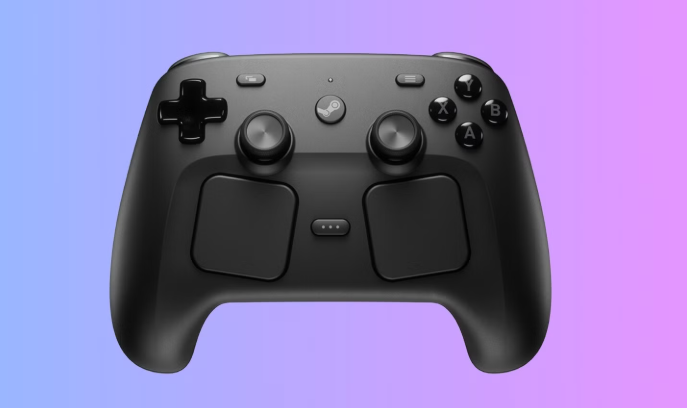
May 4. Mark it.
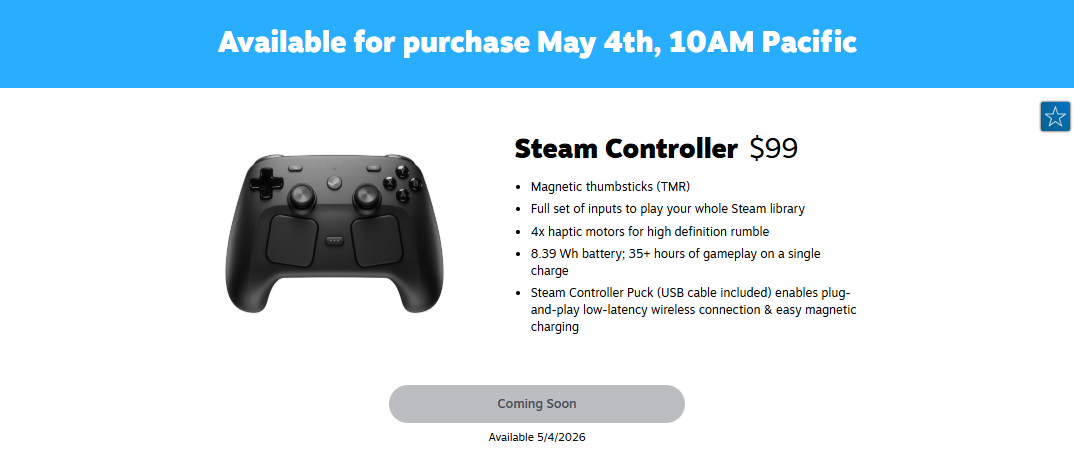
Valve just confirmed the new Steam Controller launches on May 4, 2026 at 10 AM Pacific. $99 in the US. Reviews dropped yesterday and the verdict is in. PC Gamer says there's nothing else like it for couch gaming. TechRadar calls it a massive improvement over the original. Engadget says it stands up to the competition. And the feature that should have every gamer paying attention has nothing to do with trackpads or gyro controls.
It's the thumbsticks. Because Valve just shipped a controller where stick drift doesn't exist.
TMR Is the Whole Story
Let me explain why this matters. Because if you've ever owned a DualSense, an Xbox controller, a Switch Joy-Con, or basically any gamepad made in the last decade, you've either dealt with stick drift or you're about to.
Traditional thumbsticks use potentiometers (Nerd alert). Tiny physical components that wear down over time through friction. The more you play, the more they degrade. Eventually your character starts walking on their own. Your camera drifts. Your aim pulls. It's not a defect. It's a design inevitability built into every controller using this technology. Sony has faced class action lawsuits over Joy-Con drift. Microsoft has dealt with similar complaints on Elite controllers. It's an industry-wide problem that every major hardware manufacturer has known about for years and none of them have fixed in their standard controllers.
Valve's new Steam Controller uses TMR technology. Tunneling Magnetoresistance (I know!). Instead of measuring position through physical contact, it uses magnetic fields. No friction. No degradation. No drift. The thumbsticks and the analog triggers both use it. PC Gamer's reviewer noted they didn't have to replace the sticks like they did on their Steam Deck because TMR was already built in. TechRadar confirmed there's significantly less risk of performance degradation over time.
This isn't new technology in the premium controller space. Hall effect sticks have been available in aftermarket controllers and mods for a while. But TMR is actually better than standard Hall effect. It draws less power, offers greater precision, and provides the same durability benefits. And Valve is shipping it in a $99 controller. Not a $200 "pro" model. Not a $150 esports edition. The base controller. The only one they make.
Meanwhile, Sony is still shipping the DualSense at $75 with the same potentiometer sticks that will drift in 18 months. Microsoft's standard Xbox controller uses the same tech. Nintendo's Joy-Cons are still the poster child for planned obsolescence disguised as a gaming peripheral.
That's crazy to me. Valve just solved a problem at $99 that three of the biggest hardware manufacturers in gaming haven't solved at any price point in their standard controllers.
What You're Actually Getting
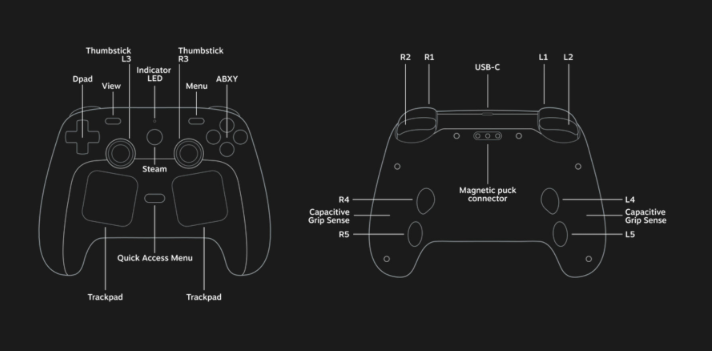
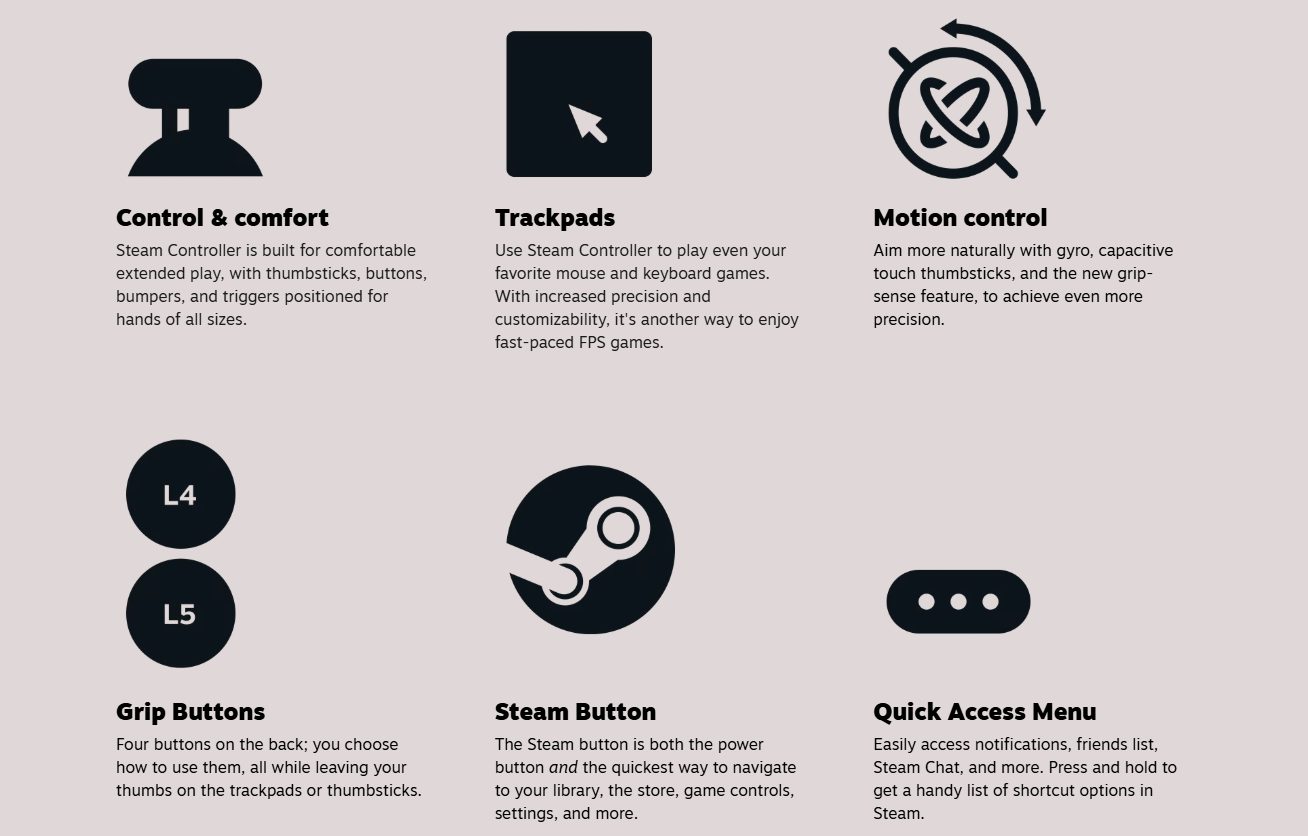
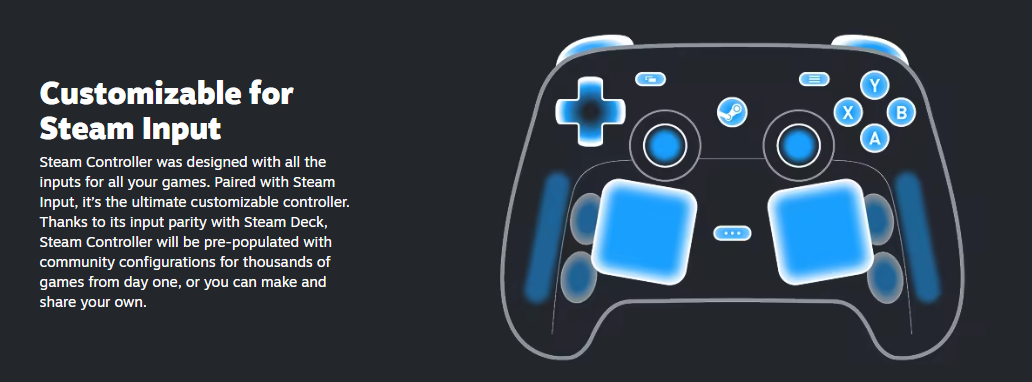
The Steam Controller is built to feel like a Steam Deck without the screen. Two full-size TMR thumbsticks. A proper D-pad (the original infamously didn't have one). Standard face buttons. Two 34.5mm square trackpads with haptic feedback and configurable click pressure. A 6-axis gyroscope for motion controls. Grip Sense technology on the back that uses capacitive touch sensors to enable or disable the gyro when you're holding the controller. Two rear buttons. USB-C charging.
The wireless connection runs through what Valve calls the Steam Controller Puck. It's a small magnetic dock that doubles as a 2.4GHz wireless transmitter and a charger. End-to-end latency sits at roughly 8ms with a 4ms polling rate. You can also connect via Bluetooth or USB-C. Up to four controllers can connect through a single Puck.
Battery life is rated at 35+ hours. That's not a typo. Thirty-five hours on a single charge. For context, the DualSense gets about 12 hours. The Xbox controller on AA batteries gets roughly 40 but you're buying batteries. The Steam Controller's rechargeable battery outpaces nearly everything on the market.
The trackpads are where this controller separates itself from everything else. You can use them as mouse inputs. Not emulated mouse inputs. Actual cursor control. Combined with the gyro, you can navigate your entire desktop, browse the web, scroll through Steam, and play any game that supports mouse input without ever touching a keyboard or mouse. For couch gaming, this is the real selling point. Windows throws up dialogue boxes that no standard controller can handle. The Steam Controller can.
The $99 Question
Is $99 a lot for a controller? Compared to the $60-$75 range where most standard controllers sit, yes. But here's the math that matters.
A DualSense costs $75 and will need to be replaced or repaired when the sticks drift. An Xbox Elite Series 2 costs $180 and still uses potentiometer sticks. A Scuf or Victrix pro controller runs $150-$200 and may or may not include drift-resistant sticks depending on the model. The Steam Controller costs $99, uses TMR sticks that won't drift, includes trackpads and gyro that no competitor offers at any price, and gets 35+ hours of battery life.
The original Steam Controller launched in 2015 at $50. Adjusted for inflation, that's roughly $70 today. The new one adds a second thumbstick (the original only had one), a D-pad, TMR technology, better trackpads, gyro controls, Grip Sense, and 35+ hours of battery. A $30 increase for that list of additions is more than reasonable.
And Valve is only selling it through Steam. No retail markup. No third-party pricing games. You buy it from Valve directly at one price. That's it.
The Bigger Play
This controller doesn't exist in a vacuum. It's the first piece of a larger hardware ecosystem that Valve is building.
The Steam Machine is coming. A console-style PC designed for the living room running SteamOS. The Steam Frame is coming. A smaller form factor device. Both have been delayed because of the ongoing RAM and SSD shortage that's driving component prices up across the entire hardware market. But the controller doesn't need expensive memory components. It's a standalone peripheral. So Valve shipped it first.
That's smart. Get the controller into people's hands. Let them experience the trackpads, the gyro, the TMR sticks. Let them fall in love with the input method. Then when the Steam Machine launches, they already have the controller. They already know how it works. The ecosystem starts with the thing in your hands.
SteamOS is already being licensed to third-party handhelds. The Lenovo Legion Go ships with it. More are coming. Valve isn't just making hardware anymore. They're building a platform. And the Steam Controller is the entry point.
Credit Where Credit's Due
I spend a lot of time on this site talking about companies that don't respect their customers. Companies that ship broken products, that charge premium prices for the same recycled technology, that treat planned obsolescence as a business model.
Valve is the opposite of that pattern. The Steam Deck proved that a gaming hardware company could ship a quality product at a fair price and support it with an open operating system that doesn't lock you into a walled garden. The Steam Controller continues that philosophy. TMR sticks that won't drift. A $99 price point. 35+ hours of battery. Full desktop control from the couch. Sold directly through Steam with no retail inflation.
And here's the part that really gets me. Valve doesn't have to do any of this. They make billions from Steam. The storefront prints money. They could sit back and never ship another piece of hardware for the rest of time and be fine. But they keep building things. They keep pushing into spaces where the incumbents have gotten lazy. They keep solving problems that Sony, Microsoft, and Nintendo have been ignoring for years.
The Steam Controller launches May 4. $99. No stick drift. 35+ hours of battery. Trackpads and gyro that turn your couch into a command center.
And somehow, the company that runs the biggest PC gaming storefront on the planet is also making the best controller.
How do these guys keep doing this?
Buy the Steam controller here - Store Page
Share this article
Comments

James Brooke
Founder & Editor
Gaming industry analyst and video editor covering gaming trends, indie games, and industry analysis.
About the author →Related Articles
Steam Machine Costs $1,049 and Can Barely Keep Up With a PS5. We Called It.
We said the Steam Machine would be over $1,000. It's $1,049. It performs at PS5 levels. For the same money you can build something 60% faster. This is dead on arrival.

Steam Deck Prices Just Jumped 44%. Gaming's Pricing Bubble Is About to Pop.
A Steam Deck now costs more than a PS5. More than an Xbox. The 1TB model is $949. When a hobby costs too much, people find other hobbies. The industry hasn't figured that out yet.

Steam Controller Sold Out in 30 Minutes: Scalpers, Crashes, and What It Means
Sold out in 30 minutes. Store crashed. Scalpers at $300. Valve built a great product and fumbled the launch.
You May Also Like

Best Games August 2026: 5 Headliners and 5 Under the Radar
Game Freak outside of Pokemon. MGS4 finally on modern hardware. Hell Let Loose Vietnam. A Marvel fighting game from Arc System Works. August is the warm up lap before September destroys everything.

Latest Patch Notes in Gaming — Week of July 20–26, 2026
Battlefield 6 put boats in the game. Heroes of the Storm reworked Ragnaros. 2XKO overhauled its Fuse systems. Phasmophobia rebuilt 13 Willow Street. Ten games patched this week — here's every update.
The Mound: Brilliant Co-Op Mechanic, Rough Execution
The insanity system is unlike anything in co-op horror right now. You can't trust your own screen. But the game around that mechanic needs work. If ACE Team keeps building, something special is underneath.