Marathon's First Week Tells a Story Bungie Doesn't Want You to Read Yet
Marathon's First Week Tells a Story Bungie Doesn't Want You to Read YetFive days. That's how long Marathon has been out. And somehow, in those five days, we've gotten delayed reviews, a battle pas...
Marathon's First Week Tells a Story Bungie Doesn't Want You to Read Yet
Five days. That's how long Marathon has been out. And somehow, in those five days, we've gotten delayed reviews, a battle pass that the community is already calling the worst they've ever seen, player counts that dropped below the free Server Slam numbers, and Bungie literally asking the press to hold off on telling you whether the game is worth your money.
And the wildest part? The actual gameplay might be pretty good.
Welcome to the most confusing launch of 2026 so far. Let me walk you through it.
The Numbers Don't Lie (But Bungie Hopes You Don't Look)
Let's start with what everybody's been talking about. Marathon launched on March 5 across PS5, Xbox Series X/S, and PC at a $39.99 price point. On its first day, the game peaked at 88,337 concurrent players on Steam. That's it. That's the all-time peak.
For context, when Bungie ran the free Server Slam test back in late February, that peaked at 143,621 players. So the paid launch attracted fewer players than the free demo. Let that sink in for a second. Over 55,000 people who showed up to try Marathon for free decided that $40 was too much to come back.
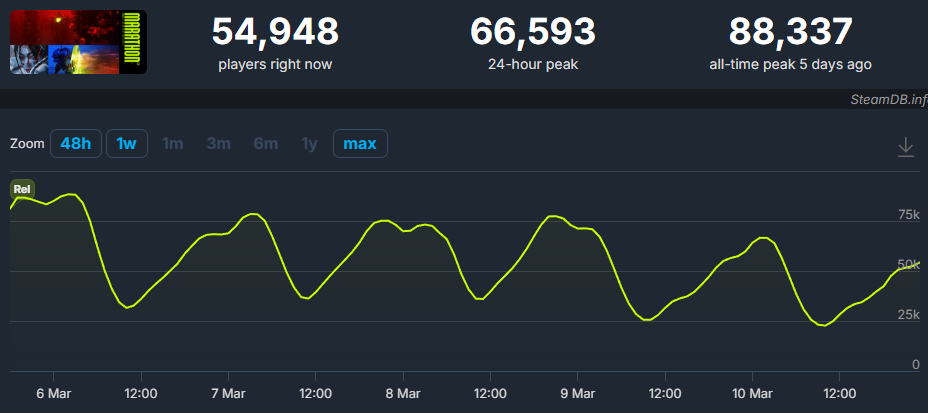
By the weekend, the numbers told an even rougher story. Instead of the surge everyone expected from Saturday and Sunday gamers finally logging in, Marathon's peak dropped to around 78,000. As of today, March 10, the game is hovering somewhere between 40,000 and 66,000 concurrent players depending on the time of day. That's a decline from launch day, not growth. For a brand new live-service game in its opening week, you want to see the line going up. Marathon's line is going down.
Now, these are Steam-only numbers. Marathon is also on PS5 and Xbox, and we don't have those figures. It's entirely possible the console numbers paint a different picture. Bungie has historically had a strong PlayStation audience thanks to years of Destiny. But Steam is the only public data we have, and what it's showing is not great.
The Arc Raiders Elephant in the Room
And here's the thing. You can't talk about Marathon's numbers without talking about Arc Raiders. Embark Studios' extraction shooter launched back in October 2025 and it has absolutely dominated the genre in a way that nobody predicted. Arc Raiders hit an all-time Steam peak of 481,318 concurrent players. It pulled in nearly 960,000 concurrent players across all platforms in January alone. Twelve million copies sold. Over $350 million in revenue. Six million weekly active users.
Those numbers are insane.
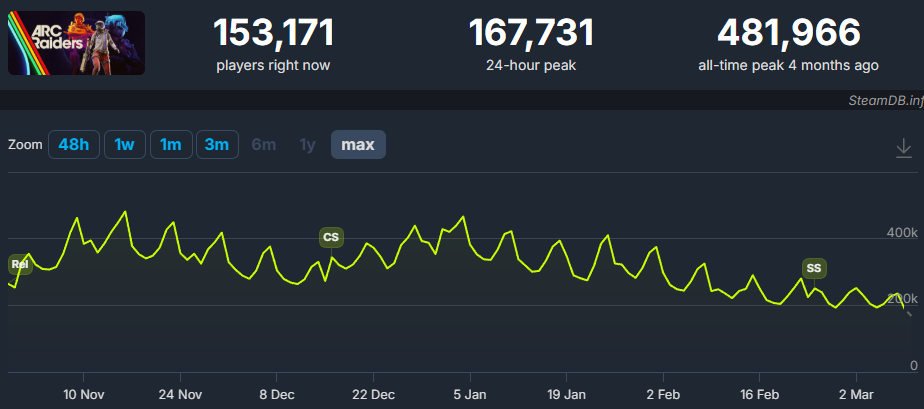
Marathon's 88,000 Steam peak is roughly one-fifth of what Arc Raiders pulled on the same platform. And while Arc Raiders has naturally declined from its peak, it still regularly draws between 150,000 and 200,000 concurrent Steam players on any given day. That's double to triple what Marathon is pulling in its launch week.
The two games are different, I'll give you that. Marathon leans hard into a punishing, PvP-focused extraction experience. It's the hardcore option. Arc Raiders is more accessible, more PvE-friendly, easier to pick up and recommend to a friend. But that accessibility gap isn't an excuse. It's the point. When you make a $40 extraction shooter that's intentionally harder, intentionally more niche, and intentionally less forgiving than the genre leader that already has 12 million players, you better make sure everything surrounding that gameplay is absolutely airtight.
And that brings me to the part where Bungie shot themselves in the foot.
The "Worst Battle Pass Ever"
I'm not being dramatic. That's a direct quote from the Marathon community. Multiple Reddit threads, thousands of upvotes, near-universal agreement. The Reward Pass, Marathon's version of a battle pass, is getting absolutely shredded.
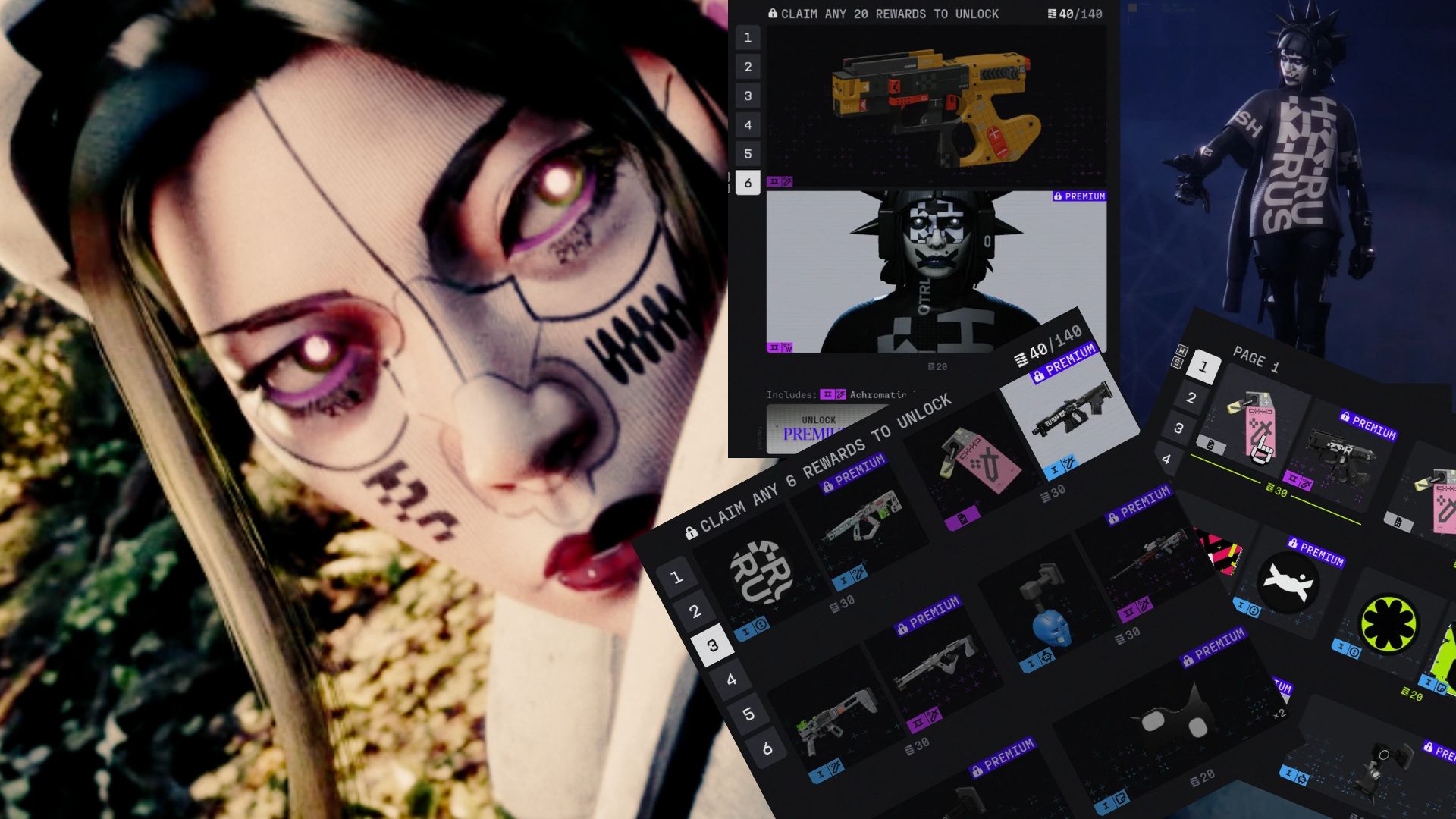
Here's why. For your $10, you get one. Single. Character skin. One. In a game where cosmetic expression is supposed to be a core motivator to keep playing, the premium pass has exactly one new character look. The rest? Recolored camos, weapon stickers that can only be applied to a single gun at a time (meaning you need duplicate stickers for each weapon), and charms that work the same way. Players are calling the contents "meh recolors" and they're not wrong.
But it gets worse. Unlike basically every other battle pass system in modern gaming, from Fortnite to Apex to Helldivers 2, Marathon's Reward Pass does not give you any premium currency back. If you buy the pass for $10, you cannot earn Lux (Marathon's premium currency) to fund the next season's pass. You're paying full price every single season. In a $40 game. That already has $15 skin bundles in the store.
And then there's the classic dark pattern that Bungie somehow thought nobody would notice. The store sells Runner skins for 1,120 Lux. The $10 Lux bundle gives you 1,100. That's a gap of 20 Lux. Which means to buy one skin, you actually need to spend $15 because you have to grab the next bundle up. That is textbook predatory pricing and the community called it out immediately.
Credit where credit's due, Bungie responded quickly. They acknowledged the Lux pricing issue and said they'd fix it. But the fact that it shipped that way in the first place tells you everything you need to know about where the priorities were when someone in a boardroom signed off on the monetization model.
The community response has been swift and clear. "Voting with your wallet is the only feedback they'll actually hear," one player wrote. "If the value isn't there, skipping it sends a clearer message than posts ever will." Sound familiar? It should. We've been saying this for years.
"Please Don't Review Our Game Yet"
This one is wild to me. Before Marathon launched, Bungie sent a communication to media outlets asking them to delay their reviews. Not a standard review embargo that lifts on launch day. They asked sites to wait until later in March to publish final scores, because more content would be coming.
Some outlets didn't even get early access to the servers. IGN's review is listed as "in-progress" and won't be finalized until the end of the month. That means if you were a consumer trying to decide whether to spend $40 on launch day, Metacritic had nothing for you. No scores. No aggregated critical consensus. Just a blank page and a price tag.
I just don't get it, man. You spent five years making this game. Sony paid $3.7 billion for your studio. You delayed the game multiple times. And when it's finally ready, your message to the press is "please don't tell people what you think yet"?
That's either a studio that knows the launch content is thin and is banking on a second wave of coverage when the endgame content drops. Or it's a studio that genuinely believes the game needs more time to be evaluated fairly. Both of those things can be true. But neither is a great look when you're charging $40 on day one.
Meanwhile, Slay the Spire 2 launched on the exact same day and pulled nearly 500,000 concurrent players on Steam. That's a sequel to a card game built by a small team. No delayed reviews. No "please wait to judge us." Just a game that showed up and delivered. The contrast is brutal.
Credit Where Credit's Due

Look, I'll be honest with you. I've been hard on this launch and the business decisions around it. But the actual game? The gameplay is solid. Really solid.
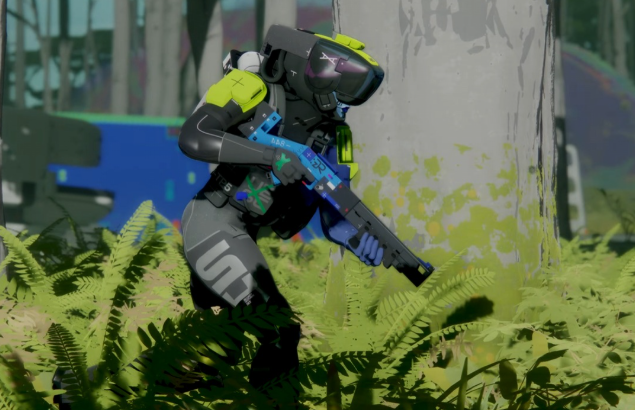
Marathon has "Very Positive" reviews on Steam with nearly 89% of over 20,000 reviews being positive. Players are praising the gunplay, calling it some of the best Bungie has ever made. The art direction is striking. The extraction loop, when you get into a rhythm with it, clicks in a way that feels genuinely different from Arc Raiders and the rest of the genre.
And here's a stat that actually matters more than the peak player count. Marathon retained roughly 78,000 of its 88,000 launch players through the first weekend. Compare that to Highguard, which launched at nearly 100,000 and cratered to 15,000 within 24 hours. Marathon didn't hemorrhage players overnight. The people who are in, are in. That's a meaningful signal.
The game also isn't trying to be Arc Raiders, and that's probably smart. At 88,000 concurrent on Steam with a $40 price tag, every single one of those players paid real money. There's a committed audience here. It's niche, but it's engaged.
The question isn't whether Marathon is a bad game. It's not. The question is whether it's a big enough game to justify a $3.7 billion acquisition, five years of development, and Sony's increasingly battered live-service ambitions.
The PlayStation Live-Service Graveyard
Because that's the context that matters most here. Marathon doesn't exist in a vacuum. It exists in the shadow of every other PlayStation live-service bet that went sideways.
Concord. Four hundred million dollars in development. Roughly 25,000 copies sold. Pulled offline in two weeks. Studio shut down.
Highguard. Launched January 26. Shutting down March 12. Forty-six days. Gone. And that's literally two days from now.
The Last of Us Online. Canceled. A live-service God of War. Canceled. Bend Studio's unannounced project. Canceled. Bluepoint Games, one of the most respected remaster studios in the industry, was shut down by Sony in February 2026 after their live-service God of War pitch fell apart.
Sony literally admitted that their live-service strategy is "not entirely going smoothly." That's corporate speak for "we have burned billions of dollars and closed multiple studios chasing this." And now Marathon is supposed to be the one that finally works?
At 88,000 concurrent Steam players, Marathon is absolutely not Concord. Let me make that clear. It's not dead on arrival. It has a real audience that genuinely enjoys it. But it's also not the blockbuster that justifies the money Sony spent to get here. And that gap between "functional live-service game" and "return on a $3.7 billion investment" is where the real tension lives.
What Happens Next
Marathon's first week is done. The numbers are what they are. But this story is far from over.
Bungie has a patch rolling out this week addressing difficulty and ammo supply issues. They've acknowledged the UI complaints that have plagued the game since the Server Slam. They're fixing the Lux pricing. They've committed to improving the Reward Pass going forward. A ranked mode is coming in the second half of March, along with an endgame zone map. Those are all good signs.
The real test is the next 30 days. Can Marathon grow? Can it pull in new players who weren't already Destiny veterans? According to analytics data, 74% of Server Slam participants were former Destiny 2 players. That's a loyalty conversion, not organic growth. Marathon needs to break out of the Destiny bubble to survive long-term, and nothing about the monetization, the review delay, or the punishing new player experience suggests that's going to be easy.
Live-service games can absolutely turn things around. The entire genre is full of comeback stories. But they can also die slow, quiet deaths when the initial window closes and the audience moves on. Highguard is being buried this week. The graveyard is right there.
Marathon's gameplay has earned it a chance. But Bungie's monetization, messaging, and launch strategy have made that chance harder than it needed to be. For a studio that spent years learning lessons from Destiny 2's worst moments, shipping a battle pass with one skin and a currency system with a 20 Lux dark pattern is not a good sign. These guys have done this before. They know better.
The game is solid. The launch is shaky. And the clock is ticking.
We'll see how this plays out. But I wouldn't be buying the battle pass just yet.